
Facts were checked October 13, 2026. Closed programs are labeled for future monitoring, not presented as current applications.
Compare five funding routes
Source: P.E.O. Program for Continuing Education
Source: Soroptimist Live Your Dream
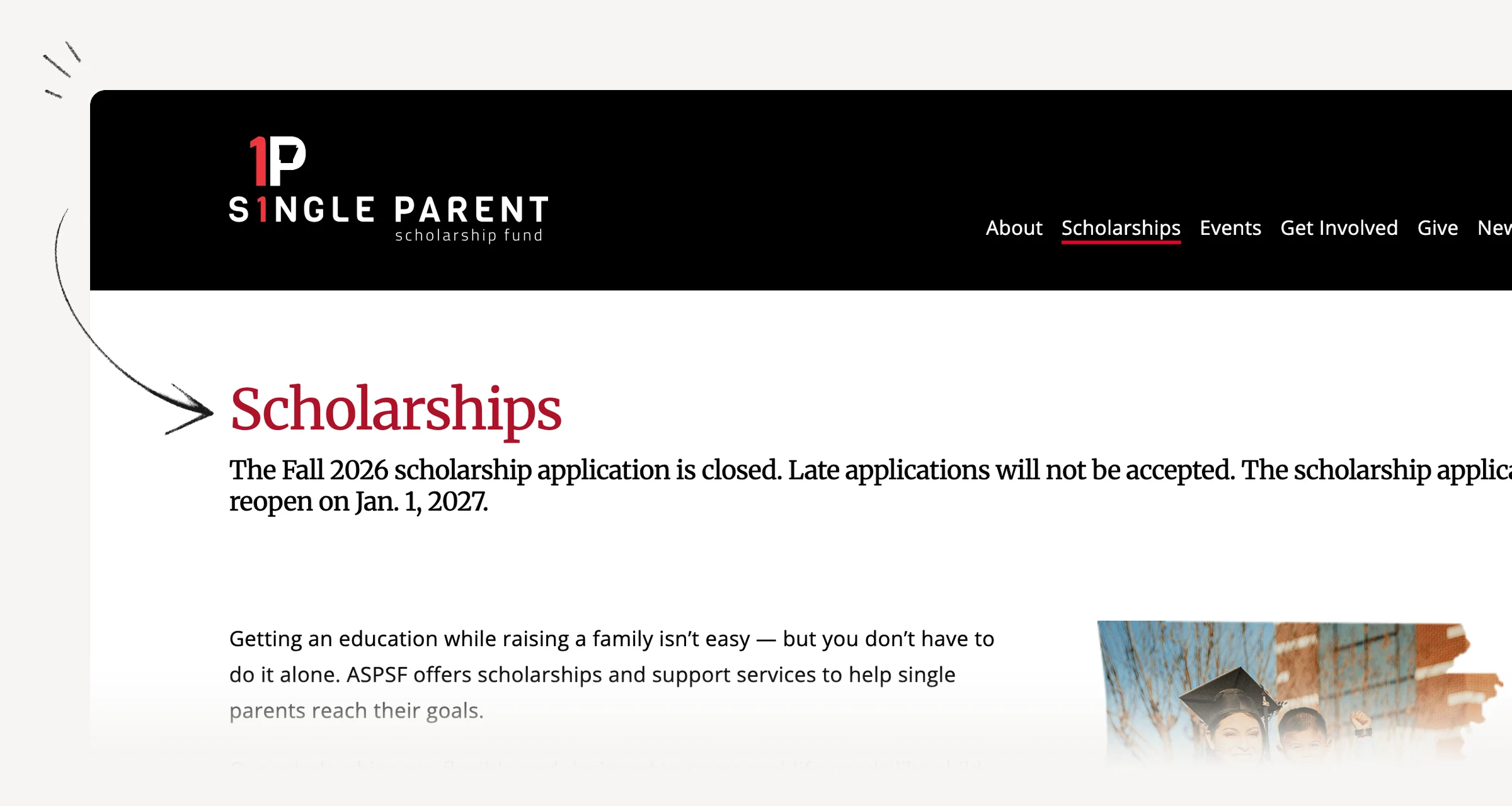
Source: Arkansas Single Parent Scholarship Fund
| Program and provider | Published support | Category and key filter | Timing |
|---|---|---|---|
| Soroptimist Live Your Dream | Potential combined awards up to $16,000 across competitive levels | Broader women’s program; primary financial provider for self and dependents; financial need; undergraduate or vocational study | Annual applications August 1–November 15 |
| Arkansas Single Parent Scholarship Fund | $400–$1,600 per semester according to credit load | Single parents in its Arkansas/Bowie County, Texas service area; excluded counties use local programs | Fall 2026 closed; reopens January 1, 2027 |
| Patsy Takemoto Mink Education Support Awards | 2026 cycle: five awards up to $5,000 each | Low-income mothers with minor children; qualifying full-time progressive education | Closed August 1, 2026; next-cycle information due May 2027 |
| P.E.O. Program for Continuing Education | One-time grant up to $4,000 | Broader women’s program; education interruption and near-completion requirements; chapter sponsorship | Chapter-mediated; no single annual deadline stated |
| Jeannette Rankin National Scholar Grant | Up to $3,000 annually; renewable up to five years | Broader women’s program; age 35+, financial need and eligible undergraduate/technical study | October 5, 2026–February 12, 2027 |
The advertised maximum is not a guarantee, and the listed programs do not all require single motherhood.
Match the program to your circumstances
You support dependents and need help beyond tuition
Soroptimist permits costs such as books, transportation and childcare. Dependents can include people other than children, and being unmarried is not its central eligibility test. Applicants must have financial need and be enrolled in or accepted to eligible education; graduate study is excluded. Awards begin at the club level, where amounts and disbursement timing vary. The $16,000 ceiling combines multiple competitive levels.
Next step: Prepare a clear education and dependent-care budget. Follow the requirement that written answers reflect your own experiences and words; do not submit a manufactured hardship story.
You live in the Arkansas program’s service area
ASPSF’s definition includes marital status, at least 50% physical custody and specific living arrangements. Living with a relative or roommate may qualify, while living with a partner or co-parent does not fit that route. The program requires a 2.0 GPA, no bachelor’s degree and household income no greater than 250% of the federal poverty guidelines. Several Arkansas counties have separate application routes.
Next step: Check your county first, then assemble marital-status proof, income documentation, FAFSA Submission Summary, transcript and class schedule. The program accepts qualifying online as well as campus study.
You are a low-income mother pursuing a more advanced credential
The Mink program’s last published cycle requires mothers age 17+ with minor children and qualifying full-time study at a nonprofit accredited U.S. institution. The education must advance beyond a credential already held rather than duplicate the same level. Its award can cover school or living expenses during enrollment. These are 2026–27 rules, not a promise about 2027–28 eligibility.
Next step: Set a reminder to revisit the official page in May 2027. Do not apply through an old duplicate page that still shows a submission link; the canonical page states the cycle is closed.
You are close to finishing after time away from school
P.E.O. requires at least 24 consecutive months as a non-student in adult life and eligibility within 18 consecutive months of program completion. A local chapter interviews and recommends candidates before the formal application. Applicants must meet its U.S./Canadian citizenship or permanent-residency rules. An existing master’s or higher degree disqualifies an applicant.
The grant can fund childcare for class or study time, but not general living expenses or loan repayment.
Next step: Use the provider’s potential-sponsorship form if you do not know a member. Prepare your completion date and a financial plan, not just an essay.
You are returning to school at 35 or older
Rankin’s National grant supports eligible women with financial need attending accredited nonprofit U.S. institutions. It is nontuition support paid to recipients rather than a universal bill discount. Check the provider’s eligibility survey for the correct geographic application route. Single-parent status alone does not satisfy its age, education and financial criteria.
Next step: Use the survey, verify your intended credential and begin its document checklist rather than relying on a category label.
Build a budget that distinguishes tuition from childcare
Consider this hypothetical planning example, not an award promise:
| Uncovered expense | Illustrative amount |
|---|---|
| Tuition after confirmed aid | $1,200 |
| Required books/equipment | $300 |
| Additional childcare for classes | $700 |
| Transportation | $200 |
| Total planning gap | $2,400 |
Now ask each provider whether its funds may cover each line. A tuition-only scholarship would not automatically solve this entire gap. Ask your aid office how outside awards are incorporated before assuming every dollar reduces your bill by the same amount.
Application questions worth answering early
- Is the provider’s single-parent definition based on marital status, custody, household composition or financial support?
- Must you already be enrolled, or is acceptance sufficient?
- Is part-time study allowed, and what credit load determines the amount?
- Can funds cover childcare or living expenses, or only specified education costs?
- Are you preparing for a verified application window or monitoring a future cycle?
These are checklist prompts, not extra universal requirements.
Are these no-essay scholarships? This page makes no such claim. Soroptimist requires written sections, and P.E.O. involves an interview and detailed finances; application effort should be checked with the provider.
Can a single father use the list? ASPSF is a single-parent program. The other listed providers describe awards for women or mothers.
Choose one good-fit application first. Funding that fits your household, course load and actual expense gap is more useful than a long list of awards you cannot use.






