“Minority scholarships” is a broad search label, not one eligibility rule. A provider may require a named heritage, attendance at a particular institution, or financial need without an identity restriction. Separate these routes before applying; outdated directories can add restrictions that current provider pages no longer list.
Verified programs by eligibility route
| Program and official source | Funding | Route and main fit | Published cycle |
|---|---|---|---|
| Hispanic Scholarship Fund | Potential $500–$5,000 | Heritage-specific; eligible Hispanic students; Scholar selection does not guarantee funding | 2026 closed February 15 |
| TMCF/McDonald’s Black and Positively Golden | Up to $15,000 for 2027–28 | HBCU-attendance route; full-time undergraduates, 2.7 GPA, qualifying citizenship, leadership and need | August 3, 2026–April 23, 2027, 11:59 p.m. EST |
| Jackie Robinson Foundation | Amount not stated on current application page | Entering four-year students, U.S. citizenship, need, academic record and service; current criteria do not list an identity restriction | January 14, 2027, 5 p.m. EST |
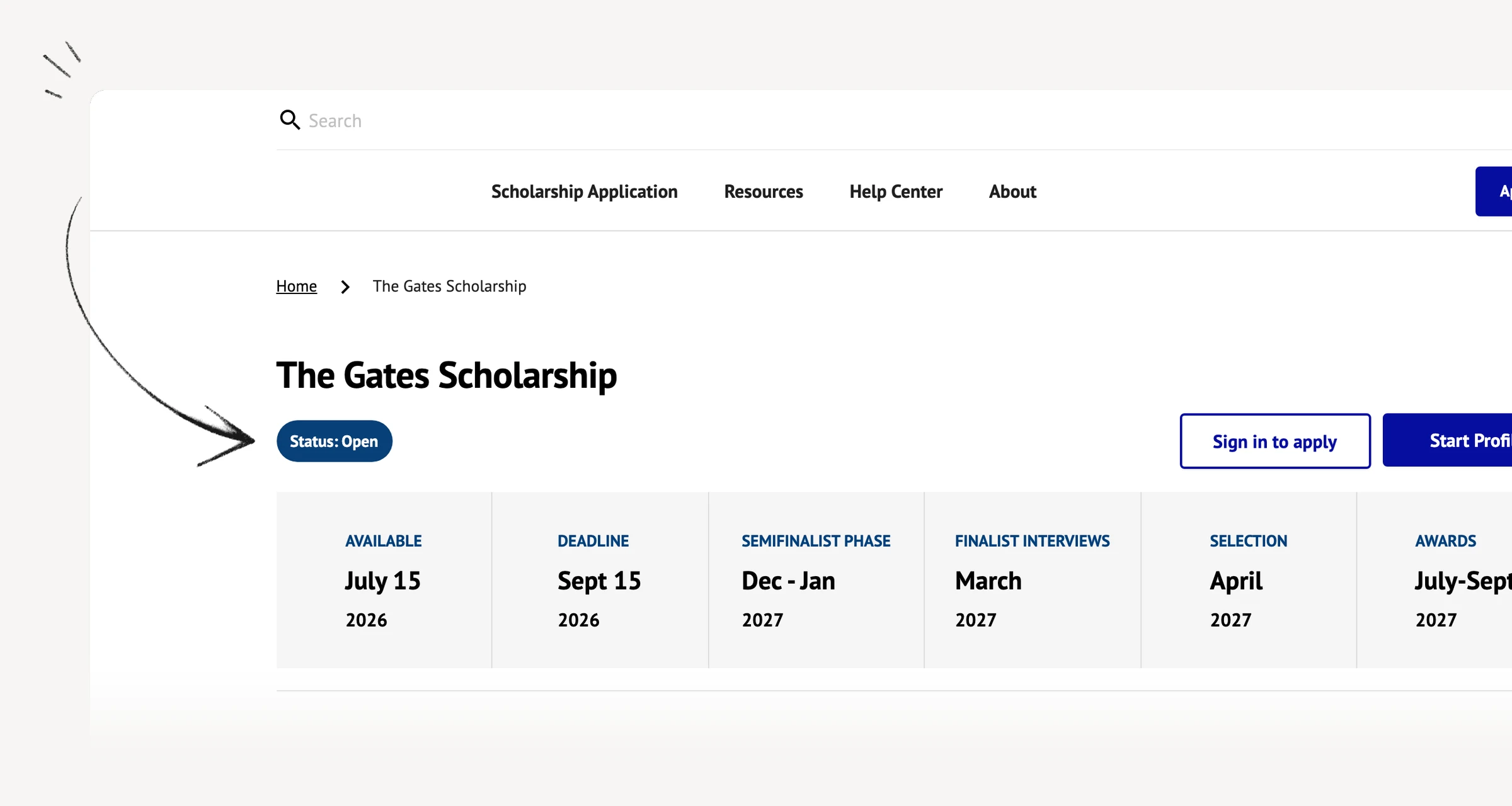
| The Gates Scholarship | Last-dollar qualifying cost of attendance | Senior, Pell-eligible, U.S. citizen/permanent resident, 3.3 weighted GPA; current basic criteria do not list race/ethnicity | September 15, 2026 deadline has passed |
Checked October 13, 2026. The last two are broader routes relevant to this audience—not claims of minority-exclusive eligibility. TMCF’s program title does not substitute for its actual institution and student rules.
Use current rules when older descriptions conflict
Gates’ current page still displays “Open” beside a September 15, 2026 deadline. The deadline is already past, so do not treat the label as permission to submit a new application. The award fills eligible cost not already covered by other aid and the applicable student-need methodology; it is not a flat dollar check. Gates cycle and funding description.
JRF’s current form includes an ACT or SAT score, CSS Profile, transcript, adult recommendation, and three brief essays. Do not assume a college’s test-optional policy removes a scholarship’s separate document requirement. Its FAQ also describes eligibility for certain prior-year graduates who have not enrolled in college coursework. JRF current application; JRF FAQ.
Institution-linked funding is its own category
The TMCF award’s explicit eligibility requires HBCU attendance in 2027–28. Its overview refers to a wider member-school network, so confirm your institution against the selected award and portal—not just the network description. Funds are allocated across fall and spring and restricted to the published eligible tuition/fee costs. The current application asks for a 200-word response about educational impact. Award-specific TMCF rules.
TMCF’s process starts with a profile and general application, then requires the materials for each matched opportunity. It says submitted applications cannot be edited and warns against duplicate accounts. Review details before final submission; a match is not an award. TMCF application FAQ.
Search a portfolio without assuming every award fits
UNCF manages multiple scholarships, fellowships, and programs with separate requirements. Its search tools can help narrow by institution and opportunity, but a UNCF listing alone does not establish that every applicant, major, or college qualifies. Treat the platform as a provider portfolio, not a single scholarship with one deadline. UNCF scholarship overview; UNCF search wizard.
Make an eligibility map before writing essays
Use columns for exact identity rule, institution, degree stage, GPA, citizenship/status, need documentation, current deadline, and renewal. Mark “not listed” rather than inventing a condition from an old article. Ask the provider privately about uncertainty; a marketing category should not become a demand to disclose sensitive family information.
Illustrative shortlist: A Hispanic graduate student investigates HSF’s stage rules instead of a high-school-only scholarship. A current HBCU undergraduate screens the TMCF award. A senior with financial need checks JRF while recognizing Gates’ past deadline. These are screening examples, not promised eligibility or outcomes.
For essays, describe true educational goals and contributions. Do not manufacture adversity, cultural affiliations, or leadership to fit the word “minority.” Reuse an evidence sheet, not identical answers to different prompts.
Next step: Select the eligibility route that fits your current stage, confirm the provider’s rules and deadline, and create a document checklist. Investigate broader academic and local funding alongside group-specific awards, clearly labeled as broader.






