Being the child of a veteran does not automatically qualify you for every military-family scholarship. Some programs require a current dependent ID and an age limit; others require a parent’s qualifying death or disability; some serve particular branches. Match the sponsor’s service category and your enrollment plan before writing an essay.
The programs below were checked October 13, 2026. None is advertised here as an application open in October: the official pages describe closed windows or upcoming openings.
Compare four verified programs
| Program and official provider | Published award | Initial eligibility screen | Next application information |
|---|---|---|---|
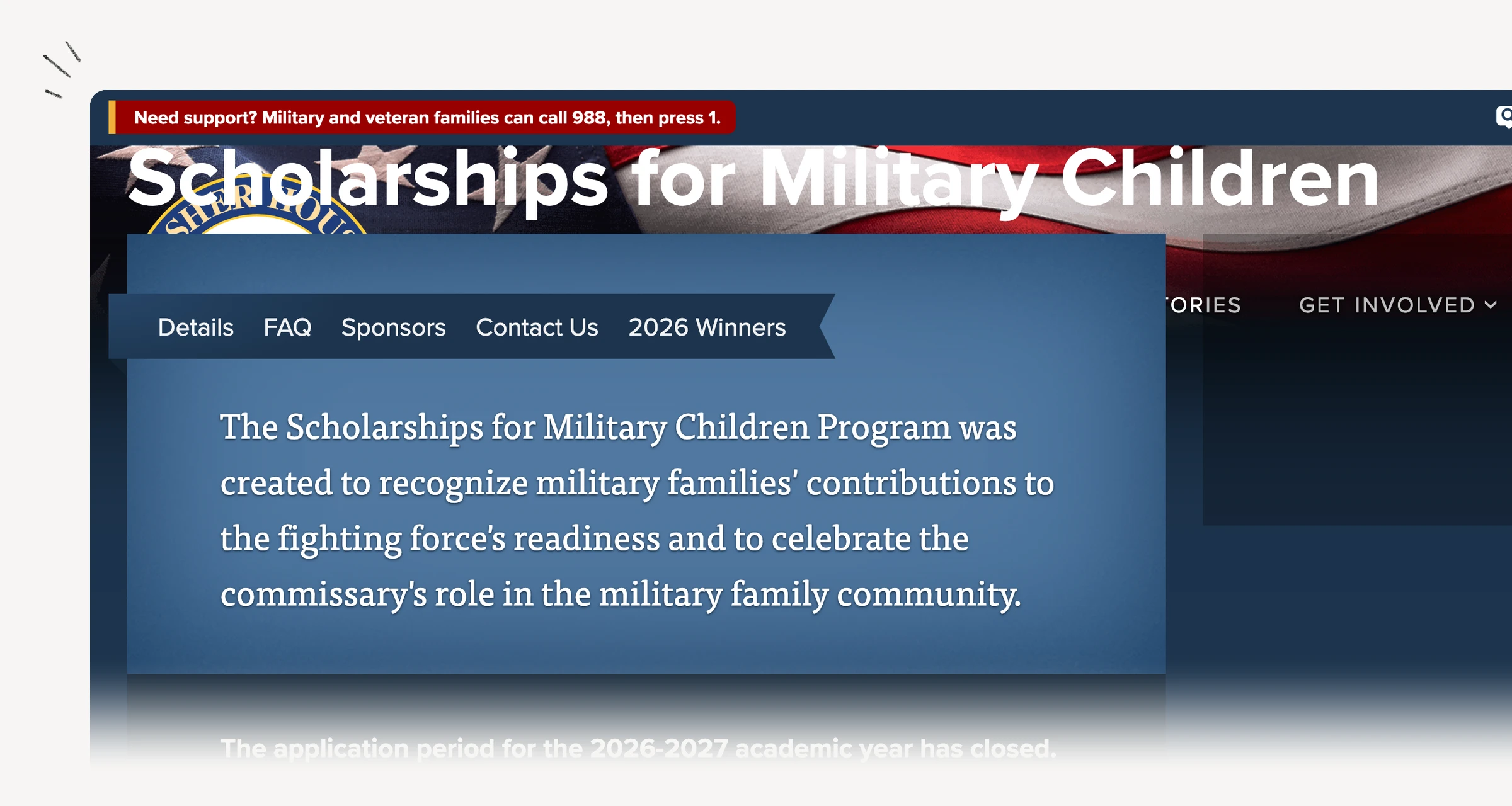
| Fisher House Scholarships for Military Children | $2,000; 500 awards announced for 2027–28 | Unmarried dependent children under 23 with valid USID; eligible sponsor category; full-time qualifying undergraduate study | Opens December 2026; exact closing date not yet listed |
| Fisher House Heroes’ Legacy | Amount and number vary with funding | Under-23 unmarried dependents with qualifying parental death/disability connected to active military service since September 11, 2001 | Opens December 2026; exact closing date not yet listed |
| Folds of Honor Military Scholarships | Up to $5,000; payments limited by permitted expenses and unmet need | Dependents/spouses of fallen or disabled U.S. service members; further higher-education rules apply | Closed; annual window February 1–March 31 |
| General Henry H. Arnold Education Grant | Variable need-based amount; no fixed current range published | Eligible Air Force/Space Force dependent children; age, service-category and full-time undergraduate rules | 2027–28 applications open early January 2027 |
These are program-specific published amounts, not guaranteed cash payments to the applicant.
Find your most relevant application route
Broad military-dependent eligibility: Fisher House Military Children
This program includes qualifying children of active-duty, Reserve/Guard, deceased and retired sponsors across the six named service branches. It funds full-time bachelor’s study or a community/junior-college route designed for direct transfer. High-school applicants need a 3.0 cumulative GPA; college applicants need 2.5, and college freshmen submit a first-semester transcript. Applicants do not need to live at an installation with a commissary; they select where they shop or the nearest commissary.
Next step: Check your ID validity and transcript, then revisit the official page in December. The provider announces a 500-word essay with the opening; do not prepare an answer to an invented current prompt. The student must complete the application.
A qualifying parental death or disability: Heroes’ Legacy
Heroes’ Legacy is narrower than “child of a disabled veteran.” Its rules distinguish death on active duty, qualifying TSGLI disability and a permanent-and-total 100% compensation rating tied to the specified service conditions. It also requires a valid dependent ID, eligible full-time undergraduate enrollment and published GPA thresholds. Award values depend on available program funding.
Next step: Compare the exact criteria with your sponsor’s documents. The application requests service dates and documentation verifying death or qualifying disability. Ask the administrator if a record does not clearly establish the listed condition; do not infer eligibility from a broad disability label.
Unmet education costs after other awards: Folds of Honor
Folds of Honor publishes an annual application window and requires reapplication each year. Its maximum is not a flat payment: disbursement depends on actual unmet need, and full awards cannot be paid in a single term. Funds go to the educational institution, not directly to the recipient.
The higher-education rules exclude expenses including off-campus housing and computers. They describe a 2.0 term GPA requirement for the two most recent qualifying terms. The provider’s definition of unmet need does not count loans or work-study as other aid.
Next step: Use the current higher-education requirements when the next portal opens. Keep a term-level bill and aid breakdown; a total household budget is not a substitute for the provider’s permitted-expense calculation.
Air Force or Space Force dependent: Hap Arnold Grant
The grant covers specified active, Guard/Reserve, retired and deceased sponsor categories; not every Reserve classification qualifies. Children must not reach age 24 during the award year. Applicants need eligible full-time undergraduate or vocational study and a 2.0 cumulative GPA. They cannot themselves be veterans or military members and must satisfy the program’s federal-aid dependency condition. Graduate/professional study is excluded.
Award amounts vary with budget, applicants, Student Aid Index and college cost of attendance. Do not carry an older grant range into a current budget.
Next step: Revisit the official page in January 2027 and obtain that cycle’s instructions. Its currently linked 2026–27 documents are not automatically the next cycle’s guide.
Prepare a sponsor-and-student eligibility record
Use this worksheet before applying:
- Sponsor: Branch, service category, relevant dates and the exact document establishing any required death/disability condition.
- Student: Age during the funding period, marital/dependent status, valid ID where required and transcript.
- School: Degree type, enrollment load, accreditation/program eligibility and expected transfer term.
- Funding: Confirmed awards, permitted costs, application window and payment destination.
Only supply documents actually requested, through the provider’s approved route. Do not paste sensitive military ID information into a public essay or discussion.
Compare funding without double-counting it
Illustrative example: A term has $4,000 in permitted costs and $3,000 in already-confirmed scholarships/grants. The planning gap is $1,000. A scholarship advertising “up to $5,000” should not be budgeted at its maximum without checking its unmet-need and term-payment rules.
This is a hypothetical calculation, not a promise about Folds of Honor’s determination or your college’s aid package. Ask the provider and aid office how outside funding is coordinated.
Quick questions
Can you apply to both Fisher House programs? Yes, if you meet each program’s criteria; eligibility for one does not establish eligibility for the other.
Are spouse awards interchangeable with child awards? No. Fisher House identifies a separate spouse program; Hap Arnold publishes separate child and spouse criteria.
Does every applicant receive the maximum? No. Heroes’ Legacy values vary, Hap Arnold is need-based, and Folds of Honor limits payments to its permitted need calculation.
Your next move is to choose the matching sponsor category, verify the current guide and build the required document checklist before the portal opens.






