Start with the Office of Navajo Nation Scholarship & Financial Assistance, then compare broader Native-student programs separately. ONNSFA serves enrolled Navajo Nation members; other providers may allow documented descendants under their own rules. Do not assume one provider’s identity documentation or degree requirements apply to all of them. ONNSFA eligibility FAQ.
The programs below are verified. Current-cycle ONNSFA dates and the other providers’ published recurring schedules were checked October 13, 2026.
Compare the funding routes
| Program | Relationship to Navajo students | Amount | Timing and official source |
|---|---|---|---|
| ONNSFA financial assistance/scholarships | Navajo Nation enrolled members; full-time and part-time routes | Not stated on cited overview; applicant/program-specific | Winter/Spring 2027 window September 25–November 25, 2026; cutoff 5 p.m. MT. Application requirements |
| American Indian Services College Scholarship | Broader Native American/Alaska Native undergraduate route; enrollment or qualifying descent documentation | Need-based; fixed amount not stated | Published January-award schedule September 1–November 1; verify term in portal. AIS |
| American Indian College Fund / Full Circle route | Broader enrolled-member or descendant route, including Navajo applicants who satisfy the rules | Varies; provider describes an average $2,000–$3,000, not a guaranteed award | Annual schedule: February 1 opening, May 31 priority review, January 25 spring consideration cutoff. College Fund |
ONNSFA: submit the right term and the right documents
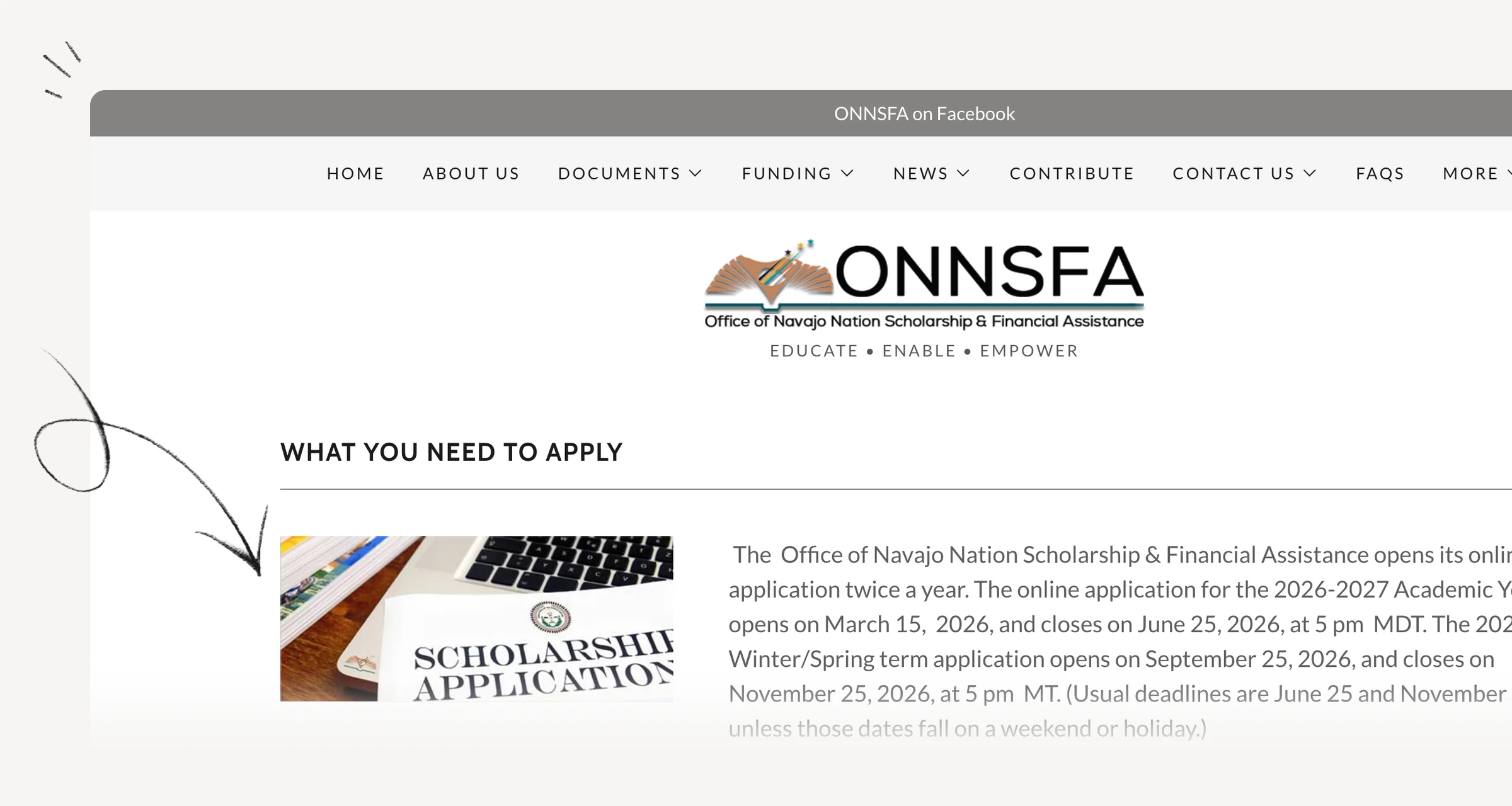
The official application page gives November 25, 2026, at 5 p.m. MT for Winter/Spring 2027. The earlier 2026–27 fall/spring academic-year cutoff was June 25, 2026; do not confuse that passed deadline with the current term route.
Choose full-time or part-time and submit the online application once. Additional documents are required. New applicants need an official CIB; continuing applicants generally do not resubmit it unless the stated exception applies. Official transcripts must use the permitted delivery method. An ordinary email attachment is not equivalent to an authorized digitally certified e-transcript.
For full-time applications, the financial-aid office completes the Financial Need Analysis. Contact that office early and follow up on whether it was sent. Use the provider’s forms and checklists, then check the status of outstanding documents through the student portal. A submitted application alone is not a complete file.
AIS: undergraduate and term-specific funding
AIS requirements include qualifying tribal enrollment or descent, an accredited U.S. institution, a first-bachelor’s undergraduate route, credit limits and at least six credits per term. A 2.25 GPA must be established and maintained after the first college term. Graduate study is excluded.
Its document process differs from ONNSFA: AIS accepts a current unofficial transcript and requires uploads; late or incomplete materials are not accepted. FAFSA evidence must show the Student Aid Index, not merely submission status. A separate essay is required, despite third-party pages that may say otherwise.
The page gives recurring January- and September-award schedules. Confirm the term/year in the application reached through its official Apply Now link; this article does not invent a portal closing time. Awards are sent to the school and depend on need, not an automatic amount.
College Fund: use the right scholarship route
The non-tribal-college page lists a minimum 2.0 cumulative GPA and full-time enrollment at an accredited nonprofit institution. It permits documented descendants of enrolled members of federally or state-recognized tribes and explains relationship documentation.
Applicants submit one annual application for consideration across the portfolio. The published average is not a promised amount. Funds go through the financial-aid office after enrollment verification.
The recurring May 31 date is a priority-review deadline, not a statement that all later applications are rejected. The January 25 spring guidance is also a recurring schedule; confirm the applicable academic year in the portal. Tribal-college students should use the separate TCU route linked by the provider rather than assuming this page is their complete process.
Avoid mixing document rules
Make one checklist per provider. As an original hypothetical example, Talia has an unofficial transcript ready for AIS but requests an authorized official transcript for ONNSFA. Talia also asks the school to complete the ONNSFA financial-needs form rather than assuming an AIS cost statement substitutes for it.
Keep sensitive identity and family documents private. Use the sponsor’s stated delivery channel, retain a submission record and verify outstanding items. Do not send originals to an unofficial directory or social-media account promising faster approval.
FAQ
Does Navajo ancestry alone qualify for ONNSFA? The FAQ identifies enrolled Navajo Nation members. Broader providers have different documentation rules.
Can part-time students apply everywhere? No. ONNSFA and AIS publish part-time routes; the cited College Fund route requires full-time enrollment.
Is an award guaranteed after I apply? No. Eligibility, a complete application and selection are distinct; budget only confirmed funding.






