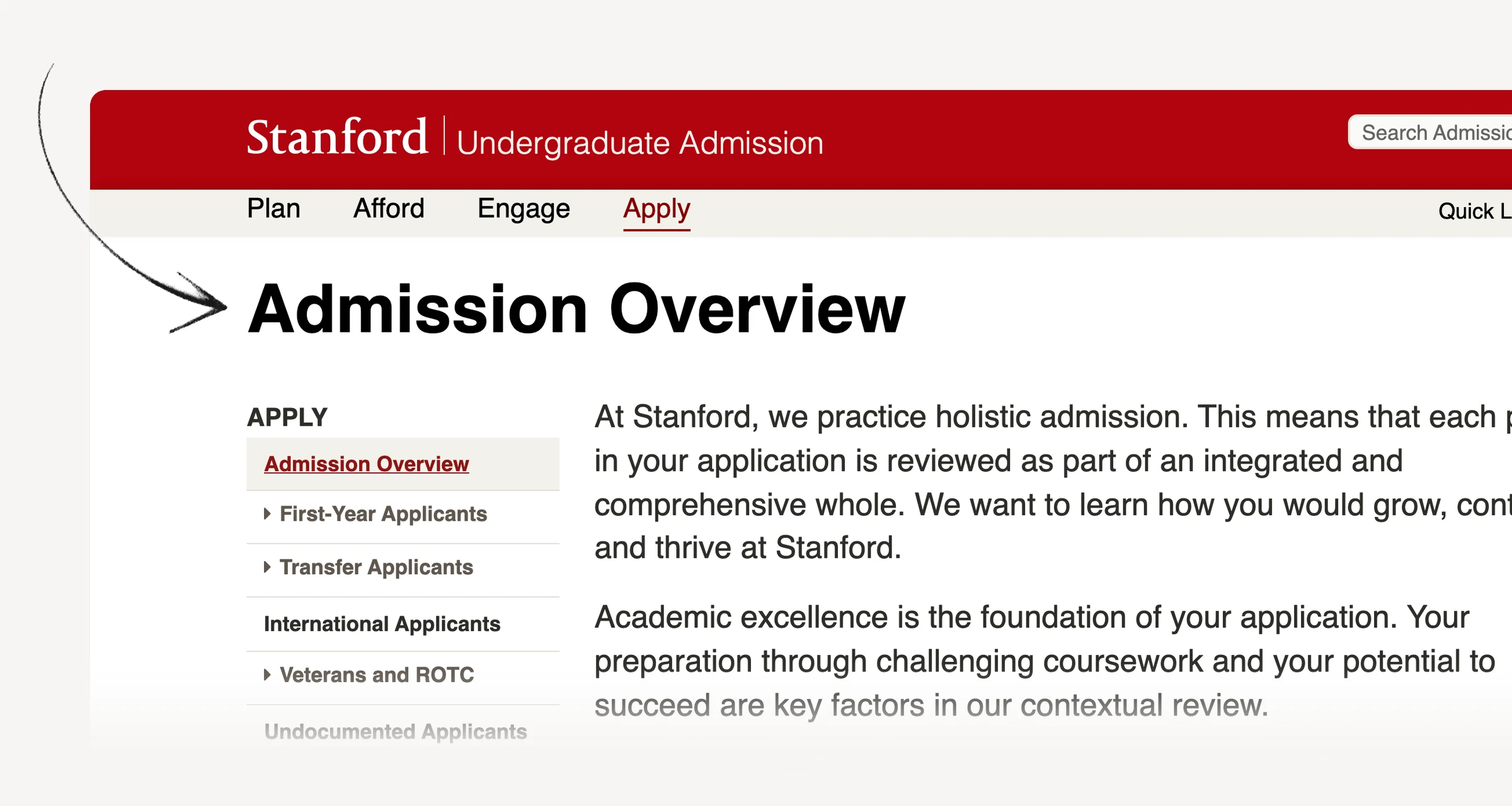
There is no universal AP-course count that guarantees admission. Choose a challenging schedule you are prepared to complete, using your school’s available courses, prerequisites, interests, and responsibilities. For example, Stanford explicitly states that it has no required number of AP or honors courses. That is one institution’s policy, not a substitute for checking your own targets.
The better question is: “Which advanced courses help me learn, and how do they fit together?” A total count cannot answer that.
Use four checks for each proposed course
| Check | What to find out | Where to start |
|---|---|---|
| Readiness | Prior courses, skills and local enrollment rules | Counselor, current teacher, official course description |
| Purpose | Subject interest or useful preparation | Your interests and prospective degree requirements |
| Workload | Typical assignments, labs, reading and peak assessment periods | Course teacher and syllabus |
| Whole schedule | How the course combines with other classes and responsibilities | Your complete weekly plan |
College Board’s enrollment guidance says academic readiness matters and that schools can have their own enrollment rules. Being willing to work is valuable, but it does not replace prerequisite knowledge.
Compare schedules, not isolated classes
Draft a complete timetable before adding another AP. Include graduation requirements, travel, paid work, caregiving, activities, and ordinary study. Ask where major projects and lab reports are likely to overlap.
A course that fits comfortably alone may not fit beside several other demanding courses. Conversely, fewer AP options at your school do not mean you should create an expensive outside schedule merely to imitate another student’s transcript. Stanford’s preparation guidance emphasizes genuine learning rather than taking every advanced course just for its designation.
An original planning example
Hypothetical: Jordan is interested in engineering and is ready for an advanced math course. Jordan also works several evenings each week. The first proposed schedule includes advanced math, two lab sciences, and a reading-intensive elective.
Jordan asks teachers about lab and assignment demands, then compares that plan with one advanced math course, one appropriately sequenced science, and a balanced set of other requirements. The decision is not that “two APs are right” or “four APs are wrong.” The decision depends on preparation, the actual workload, and what Jordan can sustain.
Write down the reason for every advanced course. If the only reason is “someone online said I need this many,” revisit the plan.
What if your school offers few or no AP classes?
First learn what alternatives your school actually provides: honors, IB, dual enrollment, advanced electives, or other approved coursework. Compare their educational fit and logistics without assuming every option transfers identically.
Ask your counselor how the school reports its offerings and course rigor to colleges. Context matters in Stanford’s published review process, but another institution can have its own required preparation. Check specific subject requirements rather than trying to compensate with an arbitrary number of unrelated AP exams.
AP courses and college credit are different questions
Taking an AP course does not automatically establish credit at your future college. College Board’s credit and placement guide explains that colleges set policies for qualifying exam scores. Verify the exact exam, required score, credit type, degree applicability, and any limitations at the institution you may attend.
A course can be valuable preparation even when it does not shorten a degree. Conversely, the possibility of credit is not a reason to ignore prerequisites or overload your schedule. Do not claim a specific dollar saving without knowing actual tuition structure and degree requirements.
Reassess before registration is final
Discuss uncertain courses with a teacher who knows your current work. Ask a precise question: “Which skills would I need to strengthen before this course, and how does its workload combine with my other choices?” Check schedule-change deadlines and consequences through your school.
If you are already struggling, get help early rather than making a rushed change based on an admissions rumor. The right next action may be tutoring, a different sequence, or a revised schedule—not necessarily abandoning advanced work.
Your next move
Build two plausible schedules and compare readiness, workload, and purpose course by course. Choose the plan you can explain as an intentional learning path, not a trophy count.