Junior-year scholarship searches should identify programs that actually accept juniors. A senior scholarship does not necessarily let you apply one year early. Record both your current grade and expected college entry term before selecting an opportunity.
Verified starting points
Checked October 13, 2026.
| Program | Targeted eligibility | Benefit | Timing/action |
|---|---|---|---|
| Coolidge Scholarship | Current juniors planning first full-time undergraduate enrollment in fall 2028; U.S. citizens or permanent residents | Four years of tuition, room, board, required fees, plus books/supplies stipend | December 1, 2026, 5 p.m. Pacific; application and references |
| Horatio Alger undergraduate scholarships | Junior route emphasizes critical financial need and perseverance through adversity; program-specific criteria apply | Multiple award programs; no single amount asserted here | Central page lists December 1–March 1 window; dated 2027 opening not independently confirmed |
| BigFuture Scholarships, class of 2028 | Eligible class-of-2028 students who complete qualifying planning steps | Drawings, not guaranteed payments; provider’s central eligibility page describes $500/$40,000 awards | Cohort rules cover December 1, 2025–November 30, 2027; individual task windows apply |

Coolidge: check enrollment timing before writing
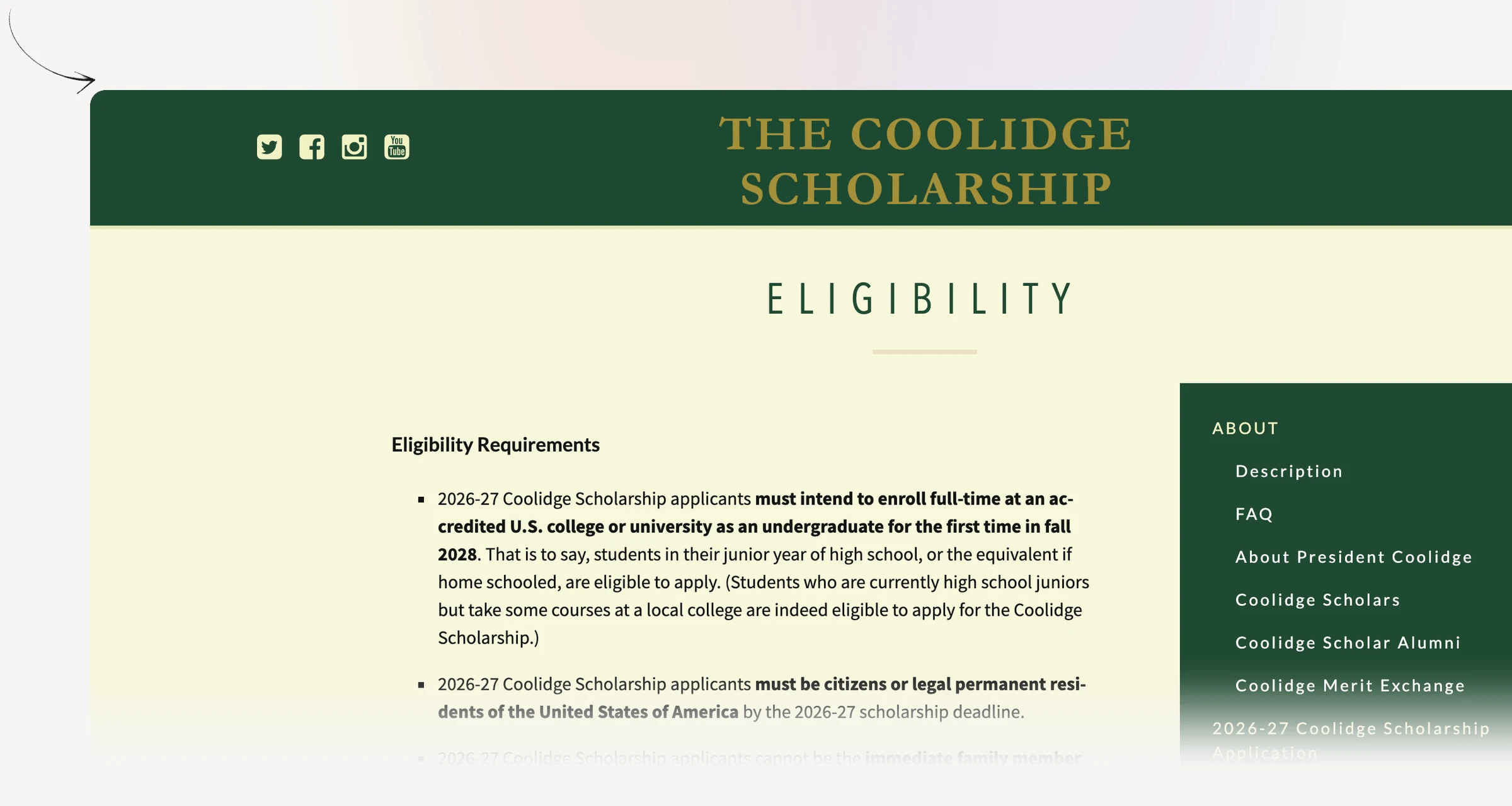
The current junior label is not enough: the 2026–27 rules require fall 2028 first-time full-time enrollment. A junior graduating early in spring 2027 or planning college after fall 2028 does not fit that cycle. Dual-enrollment coursework does not automatically exclude an otherwise eligible junior. Official eligibility
The provider’s FAQ requires two references and excludes family members and peers as letter writers. Ask recommenders who can describe your actual academic work and character. The award does not substitute for admission to a college. Coolidge FAQ
Suggested preparation step: save the reading and essay instructions, identify the required source text, and build a citation note as you read. Do not let a general scholarship essay replace answers to the program’s specific prompts.
Horatio Alger: verify the actual program, not just the brand
The association’s directory groups more than one scholarship route. Its junior section gives a December-to-March window, while a FAQ still uses “open now” wording without establishing the current date. On October 13, 2026, treat this as a program to monitor rather than asserting that a 2027 application is already open. Program directory and applicant FAQ
If adversity is part of your application, describe the effect on your education and the steps you took. Do not feel obliged to disclose details beyond what the prompt and documentation process require.
BigFuture: planning actions create entries, not entitlement
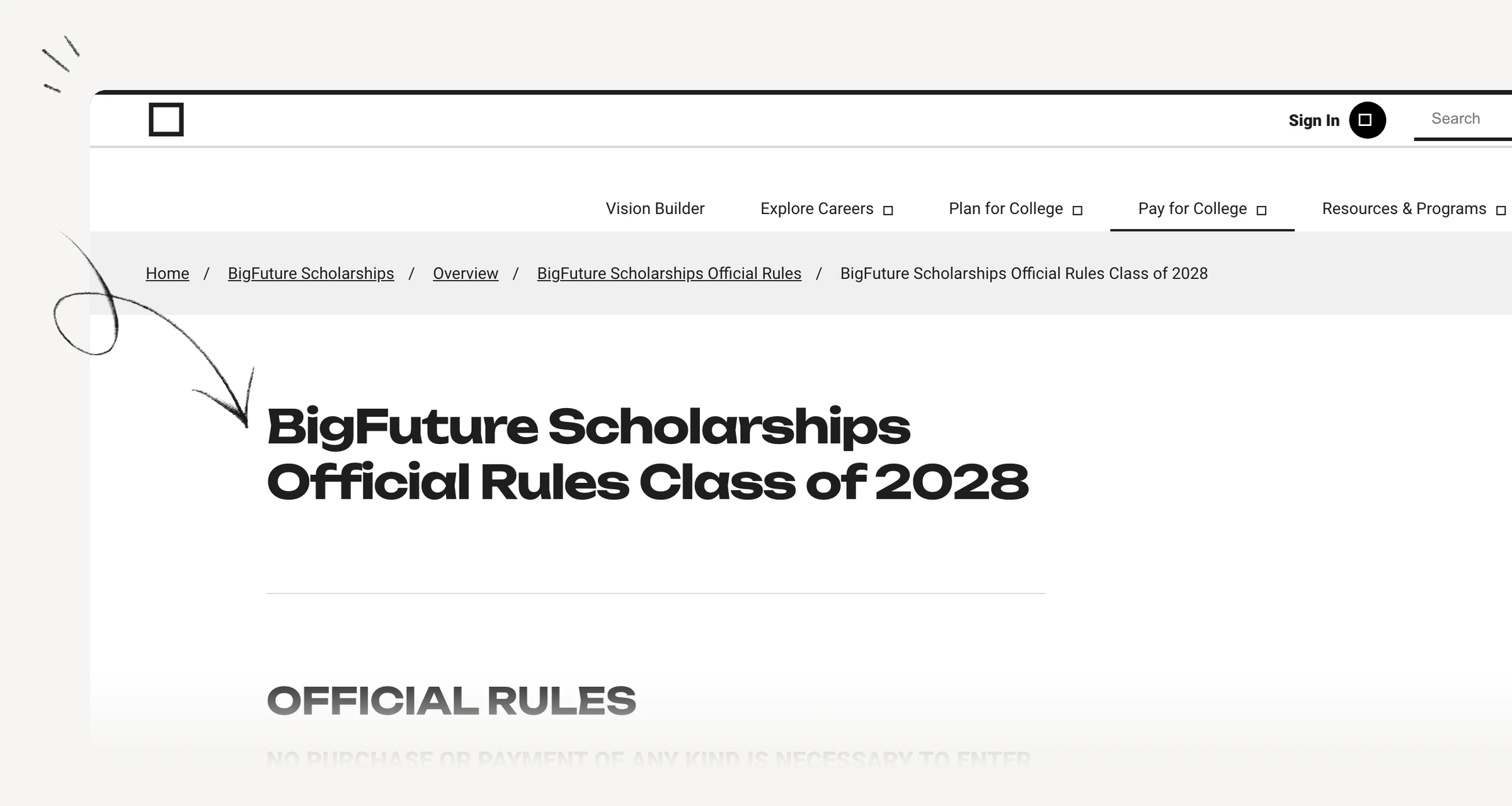
College Board uses a drawing model. Completing a qualifying action can enter an eligible student; it does not guarantee a scholarship. Check class-year eligibility and each action’s dates in the official rules. BigFuture eligibility
Use the college and scholarship planning steps for their practical benefit even if no drawing is won. Keep this route separate from merit competitions when deciding where to spend application effort.
Build a junior-year evidence folder
Save a current transcript, a plain-language activity list, work and caregiving responsibilities you choose to share, and examples of projects. Add a document titled “facts I can verify” rather than polishing every entry into an impressive-sounding claim.
Illustrative entry: “Ran weekly tutoring sessions” becomes “Prepared practice sheets and tutored two classmates weekly for one semester,” only if those facts are true. Specific work is more useful than an unsupported title.






