
Start with your training stage. A first-year education major and someone who already has a science degree but needs teaching licensure may qualify for different funding. The word “education” in your major is not enough to establish eligibility.
These are verified routes, with application status checked October 13, 2026. Scholarships and conditional federal grants are labeled separately.
Compare the main routes
| Program | Best initial fit | Funding | Status and official instructions |
|---|---|---|---|
| PDK International Scholarship Program | Qualifying association members preparing for public education careers | $500–$4,000; individual awards may be one-time or renewable | 2026–27 closed; current announcement says 2027–28 opens in December. PDK |
| AFCEA STEM Teacher Scholarships | Eligible graduate or credential/licensure students preparing to teach STEM in U.S. K–12 schools | Competitive $2,500 scholarships | Current page says applications closed. AFCEA |
| TEACH Grant — federal conditional grant, not a scholarship | Students whose school and program meet federal requirements and who can complete qualifying teaching service | Current amount must be confirmed with school; not quoted here | School-administered eligibility and counseling process. Federal Student Aid |
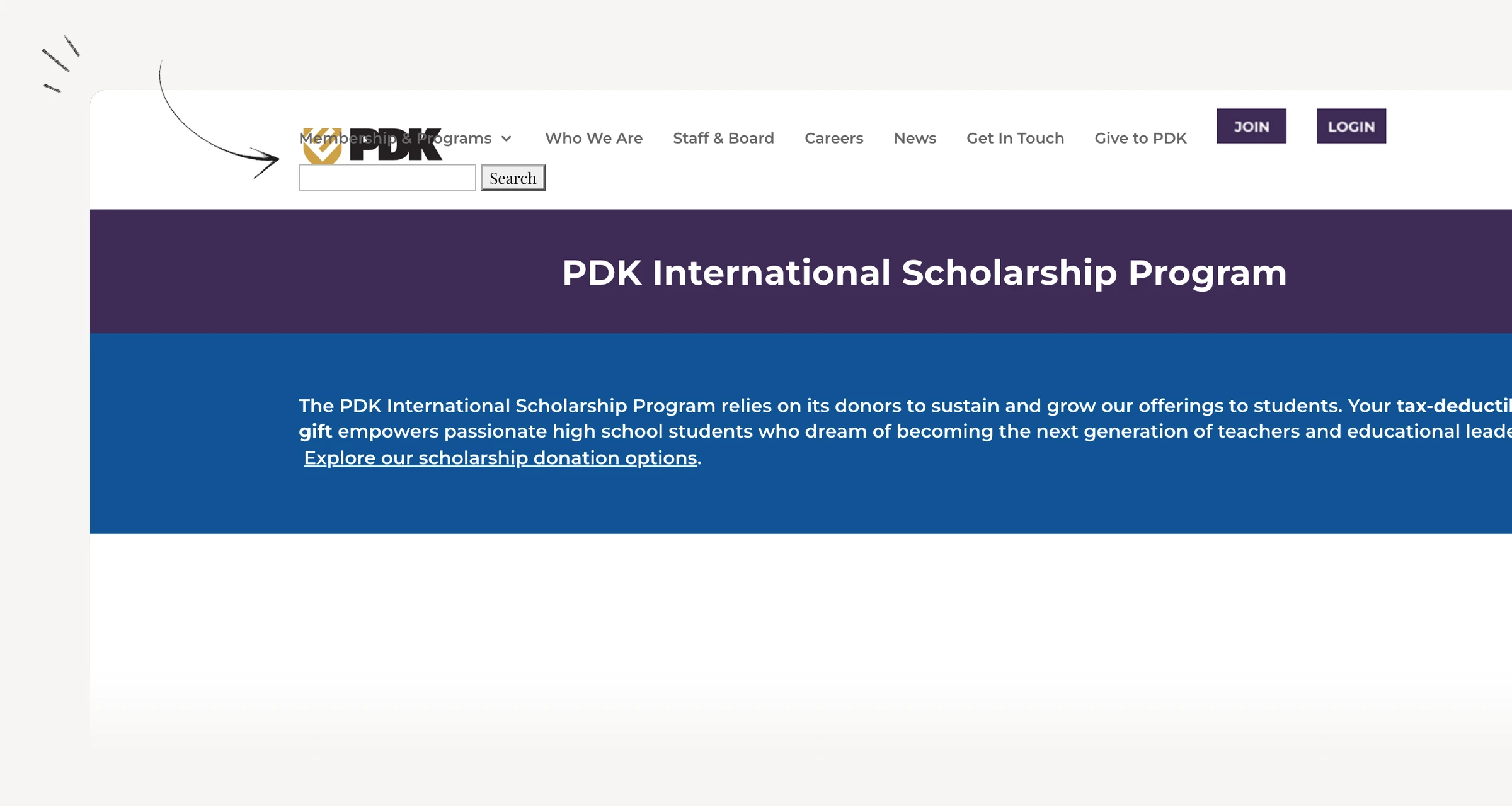
PDK: membership is a requirement, not a guarantee
The PDK provider page requires good-standing membership in one of the named associations, a public-education career goal, and qualifying higher-education enrollment with tuition and fees paid in fall. A single application is used to match applicants to eligible awards.
Prepare transcripts, a nonrelative recommendation, and specific evidence of your teaching or learning experience. For the personal statement, the page requests a reflection on education with a 250-word maximum.
Use the current 2027–28 announcement for planning, not the generic January-to-April text elsewhere on the page. Because those descriptions differ, confirm the exact next-cycle opening and deadline with PDK before setting reminders or paying for membership solely to apply. A chapter’s local award may have a separate application.
AFCEA: this is not an undergraduate scholarship
The AFCEA page excludes undergraduates. Its graduate route includes a prior STEM bachelor’s degree, education study, a current 3.5 graduate GPA, and minimum progress/enrollment requirements. Citizenship or permanent-residency conditions differ from the credential route, which specifies U.S. citizenship.
The credential/licensure route requires already-completed STEM education and a started qualifying program. Do not assume an intended future program is enough. Funding is restricted to tuition and specified course-related expenses.
Ask your program adviser which route describes your enrollment, then prepare the requested faculty recommendations and transcripts. The current round is closed; the listed May 1, 2026 supporting-document date is historical, not next year’s deadline. Monitor the provider for a new round before submitting.
TEACH: evaluate the service commitment before accepting
A TEACH Grant is not ordinary unrestricted gift aid. Federal Student Aid says that failing to complete the required teaching service can convert the grant into a loan that must be repaid with interest. The federal service framework is four years of qualifying full-time teaching within the applicable eight-year period. Official program information; federal handbook explanation.
Ask your school to explain eligible programs, qualifying fields and employers, certification obligations, counseling and the agreement you would sign. This article does not assume that every education major, school or future teaching job qualifies.
Write a separate decision note: “What must I do to keep this as a grant, and what is the financial consequence if my plans change?” Do not make the decision by looking at the headline award alone.
Make your application evidence classroom-specific
An original hypothetical example: Sam has tutored algebra and plans to teach secondary mathematics. Instead of writing “I love helping people,” Sam describes how students confused the meaning of an equation’s variable, the explanation Sam tried, and what Sam would change next time. Sam then checks whether each scholarship’s degree and membership rules actually match the current program.
Do not include students’ names, identifiable records or unsupported claims about improved grades. Reflect on your own work and preserve the privacy of anyone you taught.
Other funding questions worth asking
Ask your education department about donor-funded awards for your specialization and whether student teaching affects your enrollment classification or award renewal. Request the official application and current terms. A placement’s travel or childcare costs should be budgeted separately until a provider confirms they are covered.
FAQ
Can a scholarship pay for licensure? Some programs address credential study; compare the specific expense and route rather than assuming all awards do.
Is TEACH always free money? No. The service agreement and potential loan conversion distinguish it from ordinary scholarships.
Should I apply to a closed round? Use it as a future-planning lead. Wait for the provider’s next announced application.






