
Dental school scholarships fall into two important groups: smaller awards tied to professional interests or financial need, and substantial funding with a contractual service obligation. Neither group should be confused with dental hygiene scholarships or pre-dental undergraduate awards.
The programs below were verified on official pages October 13, 2026. Several published competitions are closed. They are included as programs to monitor, not as applications you can submit immediately.
| Program | Who should inspect it | Verified support | Application status |
|---|---|---|---|
| NHSC Scholarship Program | Eligible students preparing for primary-care practice, including the dental route | Tuition, eligible fees, other educational costs, and monthly stipends; up to four school years | Check current application guidance; opening not confirmed here |
| ADEA/Crest Oral-B Predoctoral Academic Careers Scholarships | Predoctoral students committed to dental education careers | Two $5,500 scholarships | Official 2026–27 cycle marked closed |
| ADEA/Haleon Preventive Dentistry Scholarships | Predoctoral students with academic excellence in preventive dentistry | Twelve $2,500 scholarships | Official 2026–27 cycle marked closed |
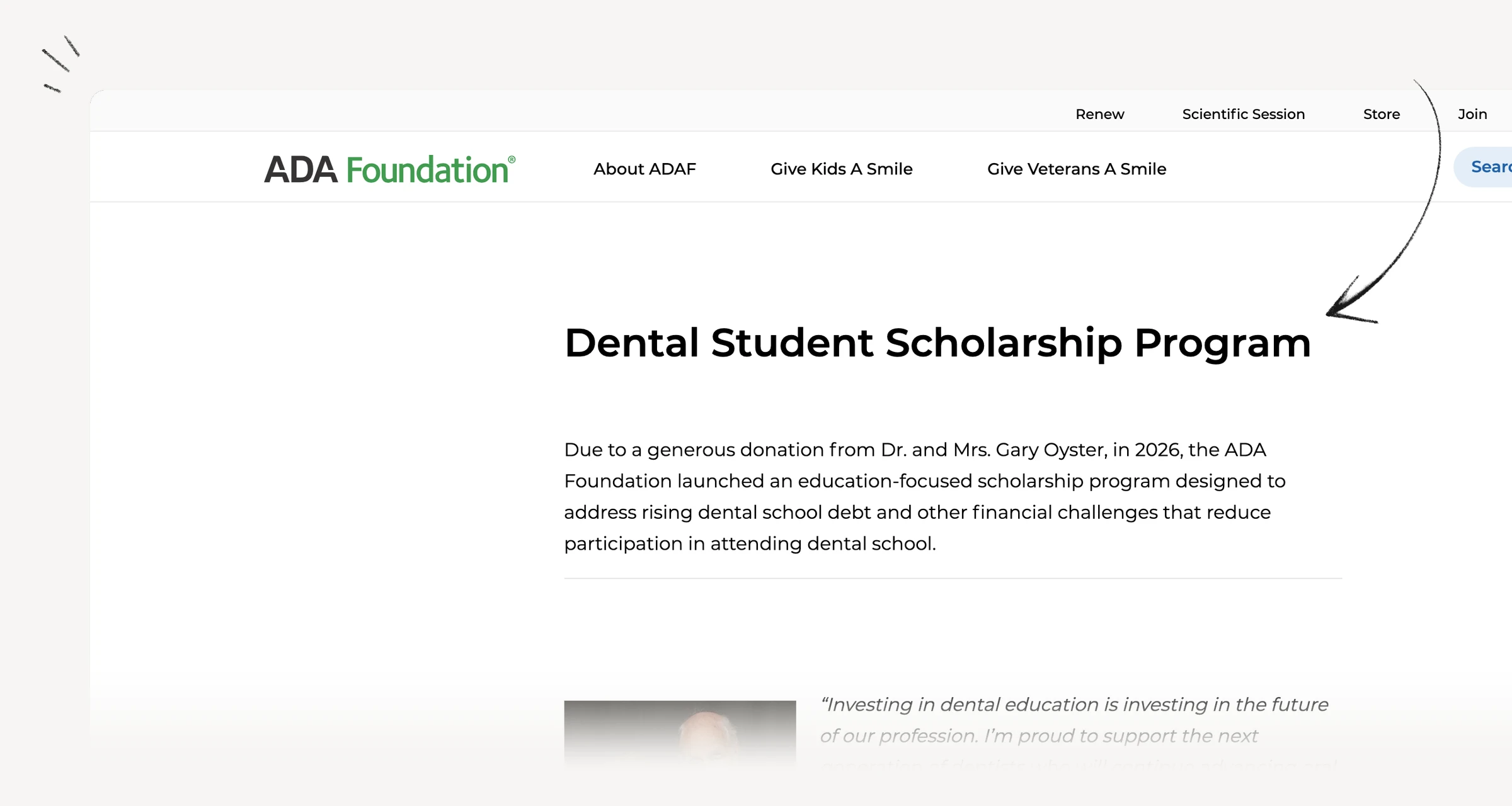
| ADA Foundation Dental Student Scholarship | Students at CODA-accredited North Carolina dental schools in the pilot | Up to two $5,000 awards | 2026 application period closed |
NHSC: examine the career commitment before the funding
NHSC support comes with service at an approved site in a Health Professional Shortage Area. The overview specifies a minimum two-year and maximum four-year full-time commitment, with the actual term tied to support received. This is not an unrestricted scholarship.
Read the NHSC service requirements before deciding whether to apply. Ask how your intended postgraduate training and practice plans fit the current rules. The overview also says postgraduate training itself is not financially supported.
A useful decision note has three parts: the education costs the contract would cover, the service locations and practice settings you could accept, and the plans you would need to change. Do not select this route solely because its advertised financial support exceeds smaller awards.
ADEA awards: match the professional focus
ADEA’s student directory separates dental hygiene, allied dental education, and predoctoral dentistry. For DDS/DMD students, use the predoctoral listings. A preventive dentistry award and an academic-career award address different achievements; one application narrative should not be copied unchanged into both.
Prepare evidence matched to the published purpose: for example, a description of a prevention project or a specific teaching experience. These are preparation suggestions, not claims about mandatory application documents. Retrieve the individual competition’s next-cycle instructions before requesting recommendations or submitting an essay.
The directory currently identifies the 2026–27 competitions above as closed. Do not infer a future deadline from a previous year’s calendar.
ADA Foundation: the pilot is geographically limited
The 2026 program requires enrollment in a CODA-accredited North Carolina predoctoral dental program, good academic standing, and financial need. It is not currently a nationwide award. The Foundation describes nationwide expansion as anticipated for 2027, which is a plan—not a confirmed future competition or entitlement.
Students outside North Carolina should monitor that official page rather than apply under the pilot rules. Students who fit the pilot should still wait for an announced subsequent cycle.
Build a dental-school funding checklist
Before comparing awards, write down your school, DDS/DMD stage, citizenship or other provider-required classification, intended practice path, and whether you can accept a service contract. Then ask your financial aid office:
- Which institutional scholarships require a separate application?
- Will an outside award change another part of my aid package?
- Is support renewable, and what standing must I maintain?
- Which expenses remain after tuition, such as equipment or living costs?
Record each answer beside the actual award. A tuition-focused award may leave a large living-expense gap; a one-time grant should not be counted in every year of a degree budget.
Can pre-dental and dental hygiene students use these awards?
Not automatically. Predoctoral dental enrollment is different from taking undergraduate prerequisites or enrolling in a hygiene degree. Use the provider’s exact degree wording. The practical next step is to open the official program that fits your stage and verify its current cycle, not to apply to every award carrying the word dental.






