Colleges do not all use the same GPA method. A school may review the GPA on your transcript, consider course rigor separately, or calculate its own admissions GPA. Report what the application requests, using your official school records. Do not choose whichever number looks most impressive or invent a conversion.
Two applicants with the same weighted GPA may have different grades, course selections, and school grading systems. A GPA is a summary; it is not a complete academic record.
Understand the three different numbers
| Term | Meaning | Question to ask |
|---|---|---|
| Unweighted GPA | A grade average without added course-difficulty points | What grade scale and courses does my school include? |
| Weighted GPA | A grade average with added weight for designated courses | Which courses get weight, and how much? |
| Recalculated admissions GPA | An institution’s own calculation using specified coursework and rules | Which years, courses, and weighting rules does this college use? |
These definitions are useful categories, not a universal formula. The University of California and University of Georgia publish different recalculation rules; their official policies demonstrate why one school’s weighted figure cannot simply be treated as every college’s figure.
A simple example of weighting
Hypothetical school policy; not a UC or UGA calculation. Assume four equally weighted courses, letter grades A, A, B, B, a base scale of A = 4 and B = 3, and a one-point bonus for two designated advanced courses that both earned A grades.
- Unweighted total: 4 + 4 + 3 + 3 = 14; average = 3.50
- Weighted total: 5 + 5 + 3 + 3 = 16; average = 4.00
The student did not earn different grades. The school applied a different calculation. Real schools may use credits, plus/minus grades, different bonuses, or different eligible courses, so this example is not a template for self-reporting.
Example: UC uses specific coursework and a weighting cap
UC’s GPA requirement page calculates its admissions GPA using qualifying A–G coursework from the summer after ninth grade through the summer after eleventh grade. It provides a capped honors calculation and distinct rules for residents and nonresidents. Nonresident school-designated honors courses do not receive the same minimum-eligibility weighting as AP or IB courses.
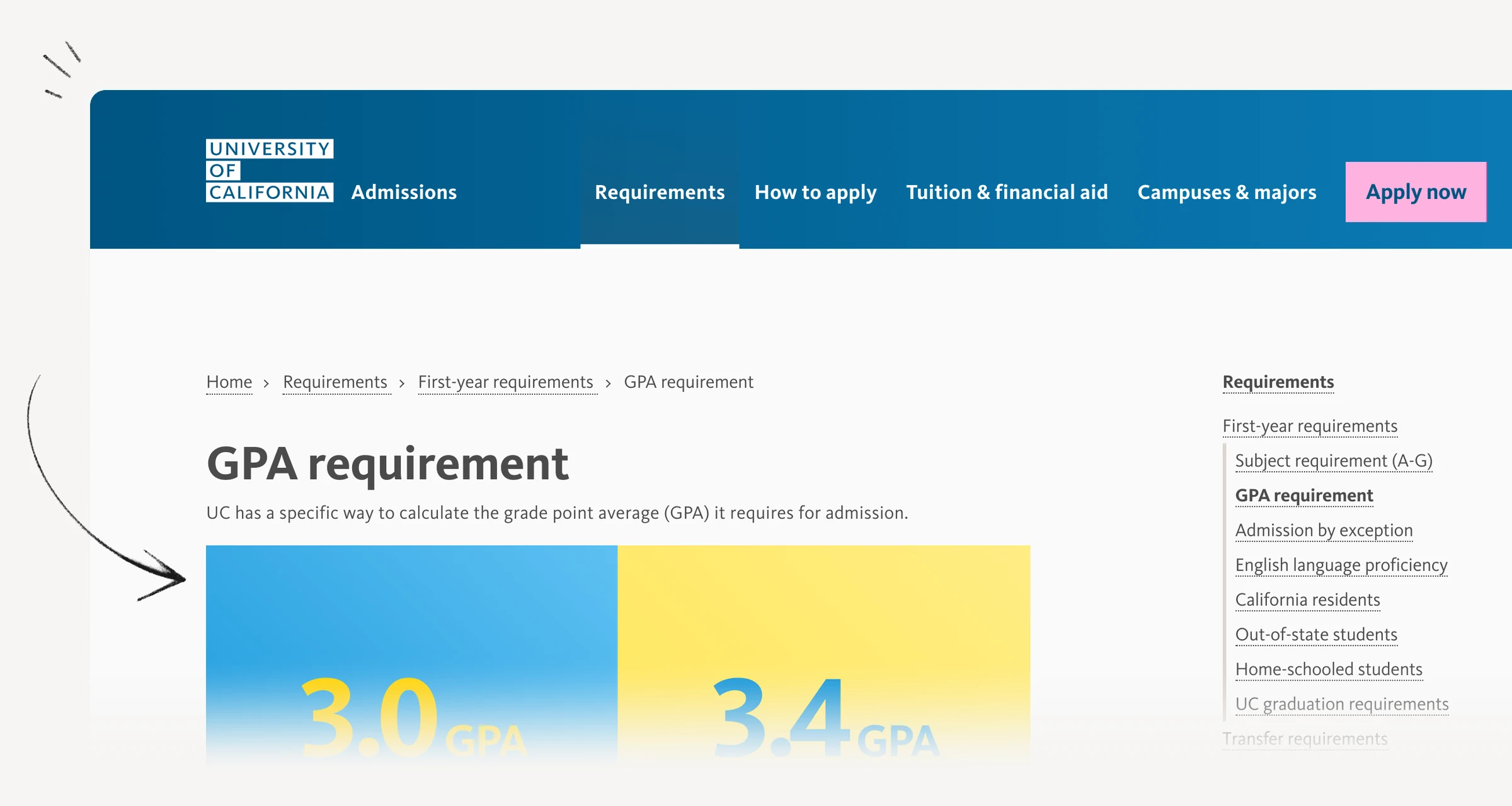
The takeaway is not to memorize a new number. It is to use the institution’s current method if you are checking its requirement. UC calculates the official UC GPA after application submission. Meeting its minimum eligibility GPA is not a promise of admission.
Example: UGA does not use every school’s bonus system
The University of Georgia’s first-year criteria explains its recalculation policy and says it does not add weight for honors or dual-enrollment courses. This is UGA-specific; it does not mean those courses lack academic value or that another institution ignores them.

When comparing an applicant’s GPA with an institution’s published profile, first check whether the profile uses school-reported grades or that institution’s recalculated number. Otherwise, the comparison may be between unlike measurements.
Which GPA should you enter on Common App?
Common App’s official high school details resource says that when a school calculates both weighted and unweighted GPA, students should report the weighted value. It also explains what to do when the school does not calculate a numerical GPA or its scale is not supported.
Use the current application field instructions and confirm the scale with your counselor. An older help article and a newer resource can use different interface wording, such as blank versus N/A. Do not force a number into a field simply because another student used one.
What to do if your school does not use a 4.0 scale
Keep the original grading system unless the institution expressly requests a conversion. Ask the counselor to identify the official scale and supply school context through the appropriate reporting channel. Percentage marks, narrative evaluations, and international grading systems do not all translate cleanly into a personally calculated 4.0 GPA.
If instructions remain unclear, ask admissions: “My transcript reports (your system). Should I enter that value, leave the GPA field unfilled, or provide a conversion using your method?” Keep the answer with your application notes.
Your next step
Get your latest transcript, confirm the school scale and weighting policy, and open your target college’s GPA instructions. Treat reporting, minimum eligibility, and competitive admission as three separate questions.