Fall 2027 admission routes
UF’s official 2026–27 application-cycle table lists three options. The exact calendar dates below map that table to fall 2027 entry:
| Route | Application | Supporting materials | Decision |
|---|---|---|---|
| Early Decision — binding | October 15, 2026 | October 22, 2026 | December 11, 2026 |
| Early Action — nonbinding | November 1, 2026 | November 8, 2026 | January 22, 2027 |
| Regular decision — nonbinding | January 15, 2027 | January 22, 2027 | March 19, 2027 |
The Early Decision enrollment-confirmation deadline is January 8, 2027; the other two routes list May 1, 2027. Do not confuse the application deadline with the materials or confirmation deadline. Check UF’s current deadline table.
Next step: If you are considering binding admission, read the Early Decision terms and investigate affordability before signing the agreement.
Testing and records: UF is not test optional

Source: Check UF’s current deadline table
UF requires SAT, ACT, or Classic Learning Test scores. Its current policy accepts self-reporting for review and explains its superscoring approach. UF’s ACT calculation uses English, math, and reading, not science. The listed academic minimums are application requirements, not an assurance of admission. Read the first-year requirements.
The materials checklist includes STARS, formerly called SSAR, or the appropriate high-school transcript, plus test scores. Follow your portal for receipt and correction instructions. See the materials deadlines.
Compare the correct cost budget
Source: Start with UF’s cost information
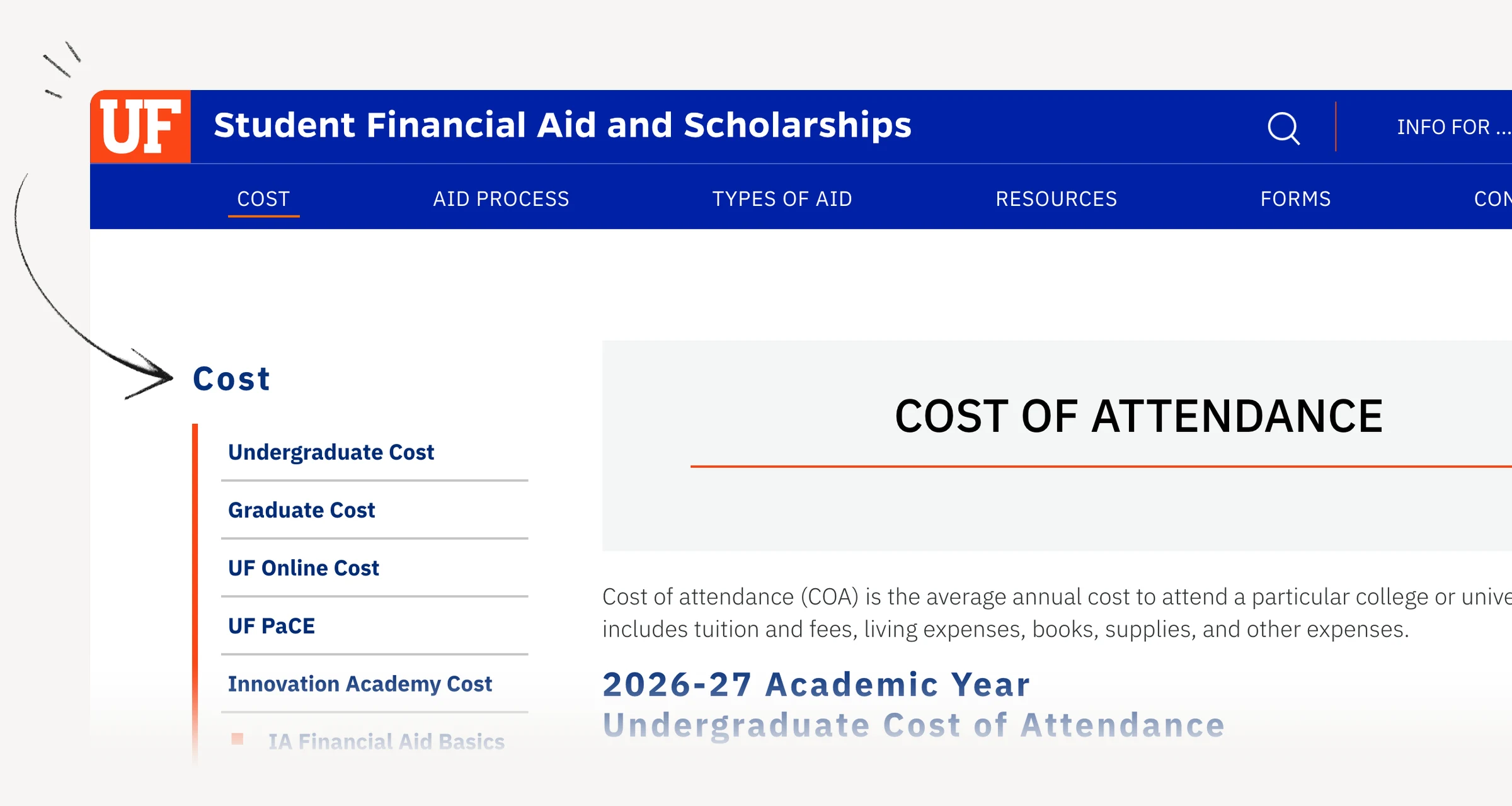
UF publishes the following 2026–27 estimates for incoming freshmen, based on 30 credits across fall and spring:
| Residency / living arrangement | Tuition and fees | Total estimated attendance budget |
|---|---|---|
| Florida resident, on/off campus | $6,440 | $25,830 |
| Nonresident, on/off campus | $34,620 | $54,010 |
| Florida resident, living with parents | $6,440 | $16,240 |
These are estimated budgets, not an individual bill or verified 2027–28 price. Total costs include living expenses, books and materials, transportation, personal expenses, and listed loan-fee allowances. PaCE, UF Online, and Innovation Academy have separate cost information. Use UF’s official cost page.
Residency is a classification, not simply an address
UF says living in Florida or attending school there does not, by itself, establish tuition residency. Classification generally requires a qualifying domicile and documentation, with exceptions described by the university. Missing documentation can result in nonresident classification. Do not budget at the resident rate before UF confirms it. Review the residency process.
Scholarships: distinguish consideration from an award
UF awards a limited number of admission-based freshman scholarships, with no separate application or additional review materials. It evaluates academic work and other application factors; similar applicants can receive different decisions. Do not assume a specific GPA or test score guarantees merit funding. Read the freshman scholarship policy.
The same page describes National Merit and Florida Benacquisto funding relationships. Those have distinct qualification rules; being interested in UF is not sufficient. Review the relevant provider requirements before including an award in your budget.
Planning action: Keep confirmed scholarships separate from hoped-for awards. Complete the financial-aid process, monitor your university account, and compare the actual offer with the correct attendance budget. Borrowing is financing, not a reduction in price.
Academic fit: inspect critical tracking

Source: Read the advising explanation
UF’s majors directory points to program-specific curriculum requirements. Its Universal Tracking system monitors progress toward the degree; critical-tracking criteria can include required courses and GPA thresholds. A semester plan is a planning model, while tracking criteria govern whether you remain on course. Read the advising explanation.
Before enrolling, compare two possible majors’ early required courses. Ask an adviser how incoming AP, IB, dual-enrollment, or transfer credit applies to your specific plan rather than assuming it eliminates prerequisites.
Your next move
Confirm your route, test and record deadlines, expected enrollment pathway, and residency classification. Then build a cost comparison using only confirmed aid. Recheck the next year’s official budget before making an enrollment commitment.
Source review: October 13, 2026. Confirm current application requirements with the provider.