Know which program you mean


Source: Los Angeles College Promise
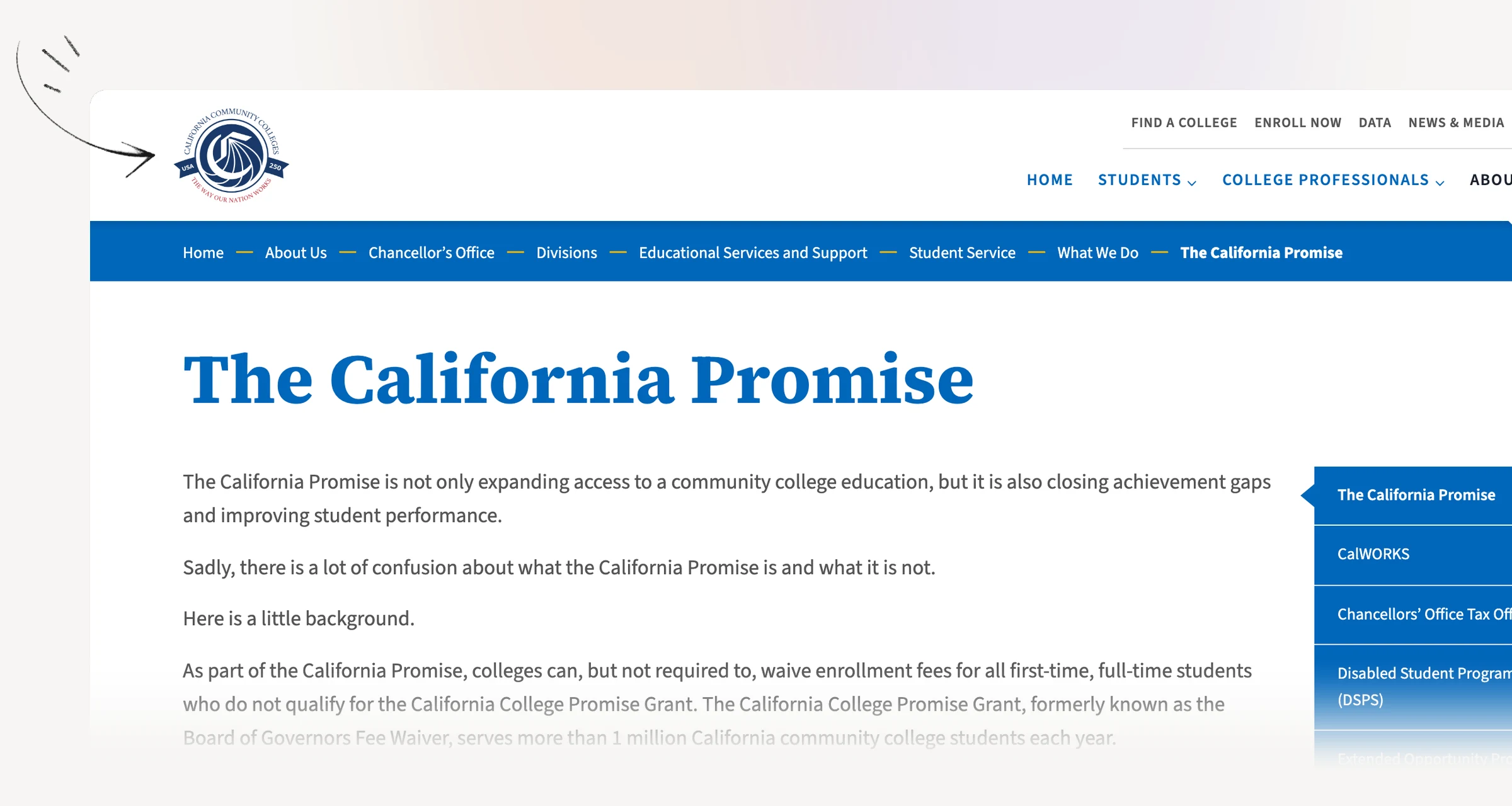
Source: California Promise distinction
| Route | What it does | What to verify |
|---|---|---|
| California College Promise Grant, 2026–27 form | Waives eligible community college enrollment fees | Financial/residency or listed special-category route and annual application |
| California Promise/local district programs | Local support can include fee waivers or other services | Actual college’s eligibility, duration and covered costs |
| Los Angeles College Promise | District program describes two years of waived tuition plus support | First-time or qualifying returning status, full-time enrollment and in-state/AB540 eligibility |
| San Diego Promise | Eligible students receive up to two years of enrollment and health-fee support | City, Mesa or Miramar route; applicant track; required aid application and units |
This is not a statewide list of supposedly free colleges. It compares programs so you can identify which rule actually applies.
The Promise Grant is an enrollment-fee waiver
The official 2026–27 application says the grant waives enrollment fees and encourages FAFSA or California Dream Act filing for other expenses such as books, food and rent. It requests 2024 tax/income information, includes dependency questions and lists special classifications. It also says recipients must reapply each academic year. Current grant application.
Do not infer that you are ineligible solely because your situation is unlike a friend’s. Bring the applicable form to the college’s financial aid office and ask which route and documents it requires. Do not copy income limits from a previous academic year.
Los Angeles: returning students have specific rules
LACCD’s current FAQ includes qualifying returning students as well as first-time students. It defines returning status using a break of two or more consecutive primary semesters/quarters and applies academic-standing and attempted-unit conditions. Continuing students enrolled in the previous semester are not eligible for admission to LACP under that FAQ. LACCD official eligibility FAQ.
Ask the particular college to confirm your history, including dual enrollment. An older campus page describing only one free year should not silently override the current district overview’s two-year description; resolve any difference with the Promise office.
San Diego: full-time requirements and tracks matter
The district publishes several applicant tracks, not merely a rule for recent high-school graduates. Its admission requirements include an active City, Mesa or Miramar application, the appropriate FAFSA/CADAA, residency classification and 12 units or an approved full-time-equivalent exception. Book grants may be available for eligible students, but the program explicitly does not cover the extra bachelor’s-course fee. San Diego eligibility and coverage.
The page’s fall 2026 instructions use the 2026–27 aid application. A student entering a later term should request that term’s instructions rather than assume an old cycle or intake deadline applies.
Calculate what remains
The Chancellor’s Office publishes the $46-per-unit enrollment fee for community college courses. Official application/cost overview.
Here is a hypothetical one-term worksheet—not a promised aid package:
| Item | Imagined amount |
|---|---|
| 12 units at $46 each | $552 |
| Enrollment-fee waiver in this example | −$552 |
| Books and supplies | $300 |
| Transportation | $200 |
| Remaining listed expenses | $500, before housing, food or other charges |
A zero enrollment-fee balance is not a zero living-cost budget. Replace the invented expense figures with your own and ask the school about any additional aid.
The application sequence
Apply to the college; submit the correct aid-year application; contact the local Promise or financial aid office; verify your eligibility track and required evidence; then inspect the revised account and remaining cost. Save the confirmation rather than assuming that seeing the word “Promise” in a brochure guarantees payment.
Your next question should be specific: “Which fee-waiver or Promise route applies to my enrollment history, and which costs will still be my responsibility?”