
The terms at a glance
| Distinction | Plain-language meaning | How to establish eligibility |
|---|---|---|
| Summa cum laude | Highest honor | Consult the applicable institution and school rules |
| Magna cum laude | Great honor | Consult the applicable institution and school rules |
| Cum laude | Honor | Consult the applicable institution and school rules |
Do not translate this table into invented nationwide cutoffs. An online GPA chart that does not identify the college, graduation year and eligible credits is not enough to determine your honor.
Why the same GPA can mean different things
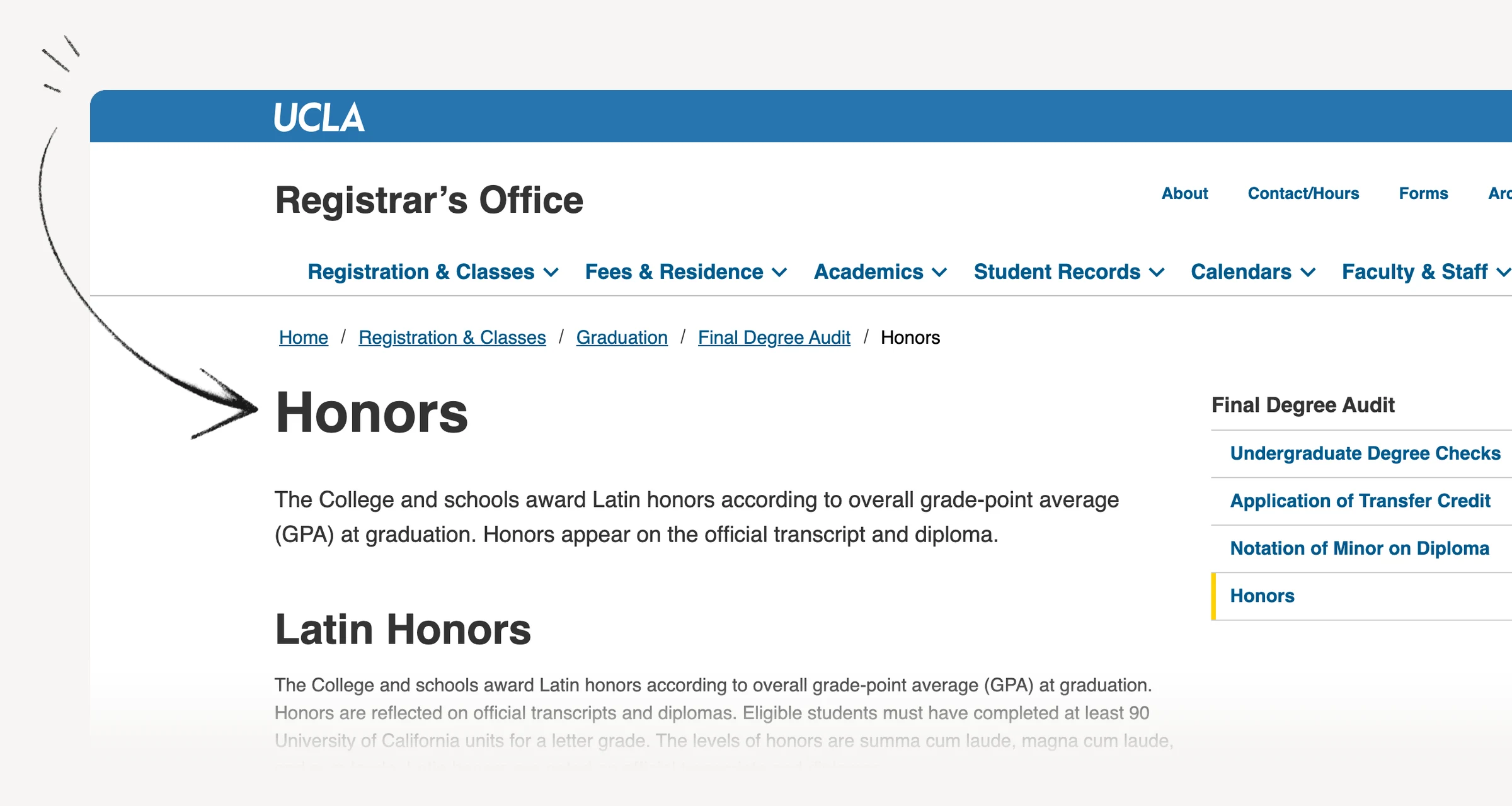
Source: UCLA graduation honors

Source: NYU Gallatin academic policies
UCLA’s registrar says its honors depend on overall GPA at graduation, requires at least 90 letter-graded University of California units, and warns that requirements may change annually. Its published table is labeled for 2025–26; this article does not repurpose that older year’s numbers as a current 2026–27 promise. UCLA honors policy.
NYU Gallatin instead describes percentile-based bands: summa goes to the top 5 percent, magna to the next 10 percent, and cum laude to the next 15 percent. It also requires at least 64 NYU credits with qualifying letter grades. Those are Gallatin’s rules, not every NYU school’s or every university’s. Gallatin requirements.
Together, the examples show why both your GPA and the definition of eligible coursework matter. Transfer credit, pass/fail credit and school-specific conditions deserve a direct question to the registrar, not an assumption.
Latin honors are not the same as an honors program

At UCLA, the registrar distinguishes Latin honors from College Honors and departmental honors. Its College Honors program has its own coursework and program requirements; simply knowing a Latin-honors GPA does not establish completion of that program. UCLA honors distinctions and College Honors program.
When reading a scholarship or graduate application, copy the exact distinction you actually earned. Do not substitute “honors college” for “magna cum laude,” or the reverse.
Check final recognition, not only commencement materials
UCLA’s 2026 Theater, Film and Television commencement instructions distinguish program recognition from the requirements for the final diploma and transcript. The page explains that final recognition requires satisfying cumulative-GPA and graded-unit conditions by the end of the last quarter. UCLA TFT commencement guidance.
A hypothetical student sees an honors notation before final grades post and plans to add it to a résumé. The careful next move is to ask whether the notation is provisional, then verify the final record. That scenario is a planning example, not a reported applicant outcome.
A short email to your registrar
“Please confirm the Latin-honors policy for my degree, school and graduation term. Which GPA and graded-credit totals are used? Are the published cutoffs final for my term? When will the distinction appear on my official record?”
Include your actual graduation term and program. If you transferred or took pass/fail courses, ask about those specifically. Save the response with your graduation checklist.
Does an honor guarantee a scholarship or admission?
Do not use the distinction as a substitute for reading an award’s or graduate program’s eligibility rules. This article makes no claim that a Latin honor produces a particular scholarship, salary or admission result. The actionable benefit here is accurate interpretation: know what your institution awards, verify that you earned it, and describe it correctly.