A useful safety school is more than a college that seems likely to admit you. For planning purposes, it should pass three tests: a realistic route to admission, an affordable funding plan, and a program you would willingly attend. This is a decision framework, not a promise of admission. College Board recommends balancing reach, match and safety choices rather than relying entirely on selective colleges. Build a balanced college list.
Use three separate checks
| Check | Evidence to collect | A reason to investigate further |
|---|---|---|
| Admission | Current requirements for your applicant type and entry term | Your conclusion depends only on a schoolwide acceptance rate |
| Affordability | Estimated net cost, then your actual aid offer | Attendance requires a competitive scholarship you have not won |
| Program access | Requirements for the intended degree and campus | General university admission may not admit you to the major |
Keep these checks separate. Excellent grades do not settle the budget question, and a low estimated price does not settle admission.
Check the actual admission route
Start with the college’s own first-year admissions page. Record required high-school coursework, how the school evaluates academic preparation, and whether your applicant category has additional requirements. ASU’s official instructions, for example, distinguish course competencies from aptitude requirements and warn that some degree programs have higher requirements. That makes ASU a useful example of why a university-level rule is not the whole story—not a universal safety recommendation. ASU first-year requirements.
A student choosing a particular major should follow the degree link and ask whether entry is direct, competitive after enrollment, or governed by separate conditions. International applicants should consult their own route rather than assuming a domestic applicant’s requirements apply; ASU explicitly publishes separate international instructions. International first-year admissions.
Make it a financial safety, too
Before applying, use the institution’s cost-estimation resources and decide what your household can actually contribute. USAGov explains how net price calculators and College Scorecard help compare costs. Once an offer arrives, replace estimates with the college’s confirmed figures. Estimate college cost.
Do not count a loan as a price reduction or treat work-study as money already credited to the tuition bill. Federal Student Aid’s comparison guide separates scholarships and grants from borrowing and earnings. Evaluate aid offers.
Make two budgets: one using confirmed grants and scholarships, and another showing any borrowing required. If the first is unaffordable and the second exceeds your borrowing comfort level, keep looking rather than labeling the school safe.
A realistic planning example
Consider a hypothetical applicant who likes two public universities. At the first, the student appears to meet the published university requirements, but the desired degree has a separate admission condition. At the second, the degree route fits, but the budget works only if the student receives an unconfirmed merit award.
Neither belongs in the fully checked column yet. The next moves are different: ask the first school’s department about degree access; ask the second school’s aid office which awards are automatic, competitive or still undecided. A third option with a documented admission route and affordable confirmed cost may provide a more dependable backup, even without the most recognizable name.
How many should you include?
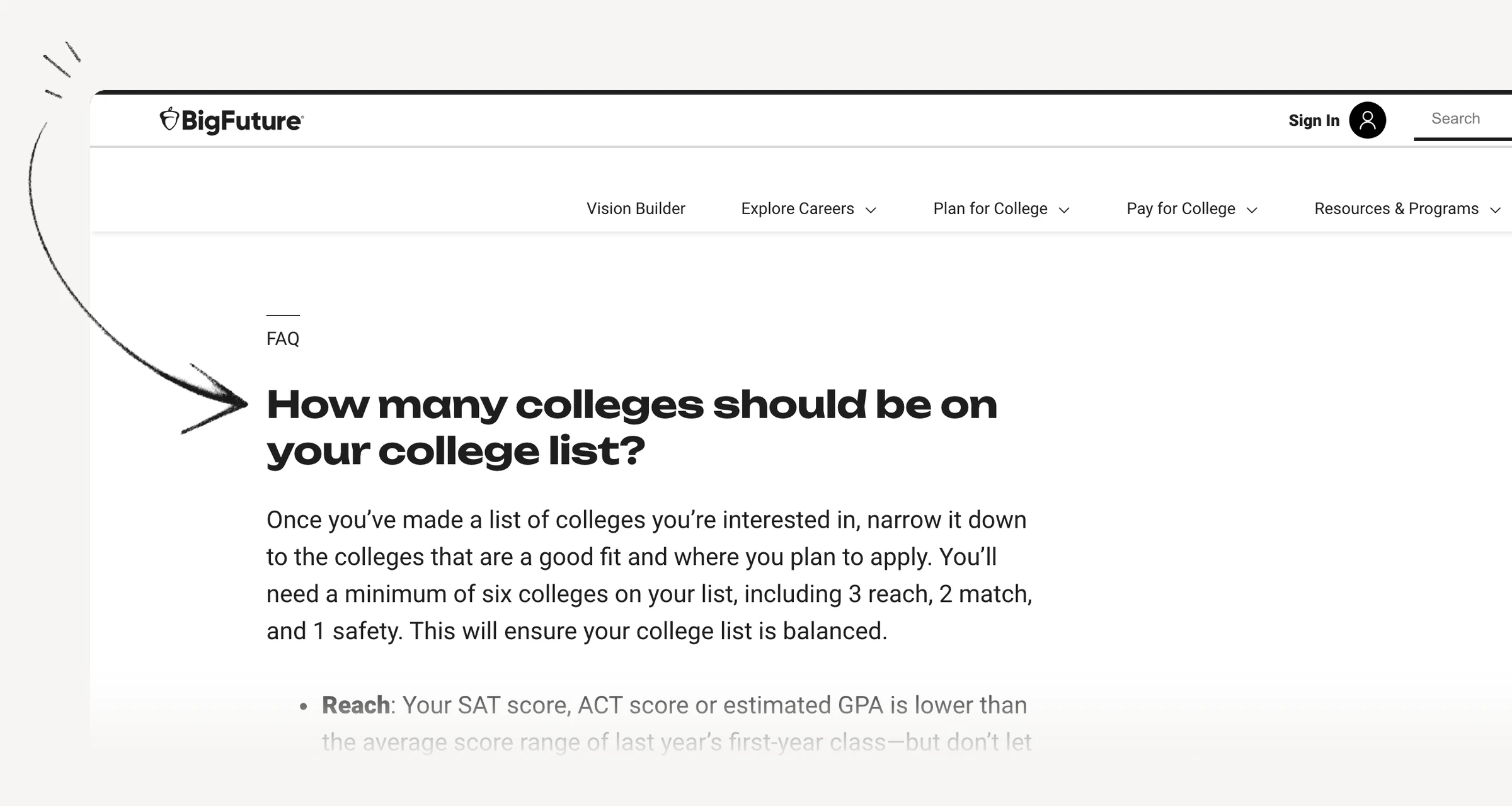
College Board gives one planning model: six colleges comprising three reach, two match and one safety. Treat that as its guidance, not a nationwide requirement or a guarantee. Application fees, program availability and the certainty of your affordable options may justify a different list. College Board list guidance.
Before you submit, ask yourself: “Would I enroll here if my other applications failed?” If the answer is no, research another option now. A backup is useful only when it remains a real choice.