Ask two questions, not one
| Question | What you need to learn |
|---|---|
| Will requesting aid affect admission for my applicant group? | The relevant need-blind or need-aware policy |
| If admitted, how will the school determine and meet my need? | The aid methodology, documentation and resulting offer |
A school can have generous aid for admitted students while considering financial need during selection for some groups. Stanford’s international page gives exactly that example: aid requests are a factor for applicants outside its listed U.S./eligible categories, but it commits to meeting demonstrated need for admitted students who requested aid during admission. Stanford international rules.
Identify the group the promise covers

Do not use “international” as a guess based solely on where you attend high school. Read the school’s own citizenship and applicant classifications. Also check first-year versus transfer admission and the actual entering class.
Brown’s current instructions say need-blind admission applies to international first-year applicants beginning with the Class of 2029, which applied during 2024–25 and entered in fall 2025. That change is already in effect as of October 13, 2026—not a future proposal. Brown international applicants.
Brown’s general financial aid page separately says it continues to consider transfer students’ need in admission. Do not extend its first-year promise to transfer applicants. Brown admission/aid policy.
“Full demonstrated need” is not whatever you hope to pay

Source: Harvard aid principles
Harvard describes an individualized calculation and aid package, with family resources and the student’s circumstances part of the process. The phrase therefore refers to the college’s determination, not a guaranteed zero bill for everyone. Harvard’s calculation overview.
Here is an original, hypothetical explanation—not any institution’s formula:
| Item | Imagined amount |
|---|---|
| School’s assessed annual budget | $60,000 |
| School’s assessed family contribution | $15,000 |
| Demonstrated need in this illustration | $45,000 |
An institution that covers the illustrated $45,000 has not made the hypothetical $15,000 contribution disappear. Ask what the actual package includes and which costs remain outside it; never assume that “need met” equals every requested expense funded.
Be accurate about aid need when applying
Source: Stanford international policy
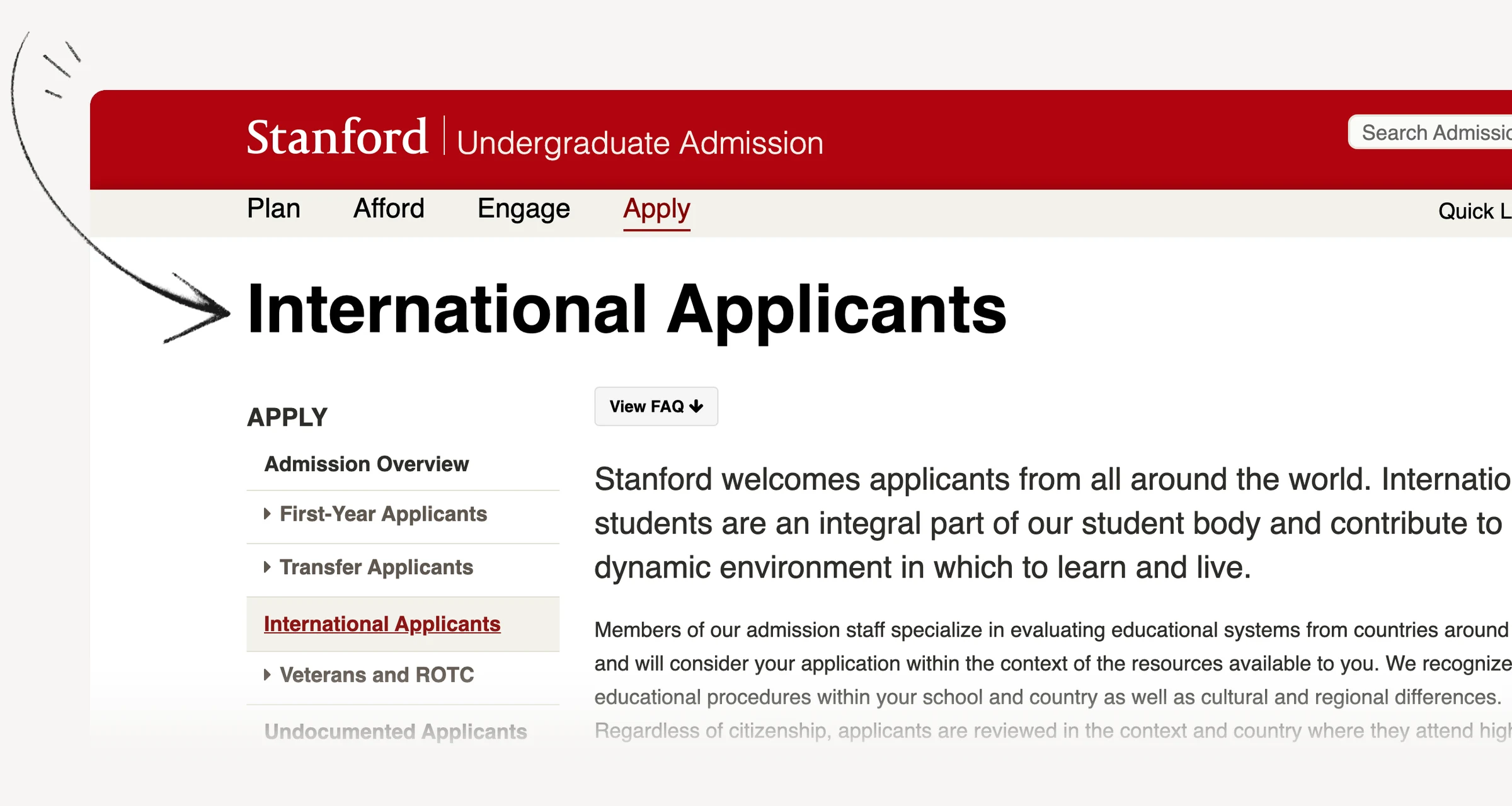
Stanford warns that international citizens admitted after indicating they would not seek aid cannot apply for aid during their four undergraduate years, subject to its stated citizenship-status exception. This makes misrepresenting your funding plan particularly risky. Stanford application consequences.
Brown also conditions international aid on requesting it at application. Its page says aid can help with books, travel and personal costs but not vacation and summer expenses. Brown international financial aid.
Do not hide a genuine funding need as an admissions strategy. Ask the institution about unclear forms, fee waivers and required documentation instead.
A practical comparison example
A hypothetical international first-year applicant compares Harvard, Brown and Stanford. The student should record each current admission policy and aid-application requirement separately, then use actual offers to assess affordability if admitted. The labels alone do not produce a personalized admission probability or guarantee an affordable outcome.
A hypothetical transfer applicant should make a new comparison rather than reuse the first-year spreadsheet. Brown’s explicit transfer distinction shows why that second check matters.
What to ask before applying
“I am applying as actual first-year/transfer and citizenship category for entry term. Does your need-blind policy apply to me? Must I request financial aid now? Which forms and deadlines apply? How do you calculate demonstrated need, and which expenses may remain?”
Save the response and the official page. Then complete both admission and aid requirements. A well-read policy helps you choose realistic applications; it is not a substitute for a confirmed financial plan.