
Merit-based aid recognizes achievements, talents, or other provider-defined qualifications. Need-based aid depends on a financial assessment. An award can combine both: a student may have to demonstrate academic achievement and financial need to qualify.
Do not choose only one search route based on the label. Read the actual eligibility rules and complete the forms required by each provider. A scholarship is not automatically merit-only, and a grant is not proof that every applicant qualifies. Federal Student Aid’s glossary describes scholarships as potentially merit-based, need-based, or directed to particular groups.
| Question | Merit-based route | Need-based route |
|---|---|---|
| What is being evaluated? | Provider-defined achievement, talent, or qualifications | Financial circumstances under the applicable methodology |
| What evidence should I check for? | Grades, activities, audition, portfolio, or other stated criteria | Required financial aid forms and supporting information |
| Is there one universal application? | No; school and outside-award processes differ | FAFSA is central to federal aid, but institutions can require additional processes |
| Can the award combine both? | Yes, if the provider’s rules say so | Yes, if the provider’s rules say so |
Merit aid depends on the provider—not just a high GPA
A school may consider achievement, a specialized field, athletics, or other criteria, as explained in Federal Student Aid’s aid-offer guide. Automatic admission-based review and separate scholarship applications are different possibilities. Ask which process applies rather than assuming your admission application covers everything.
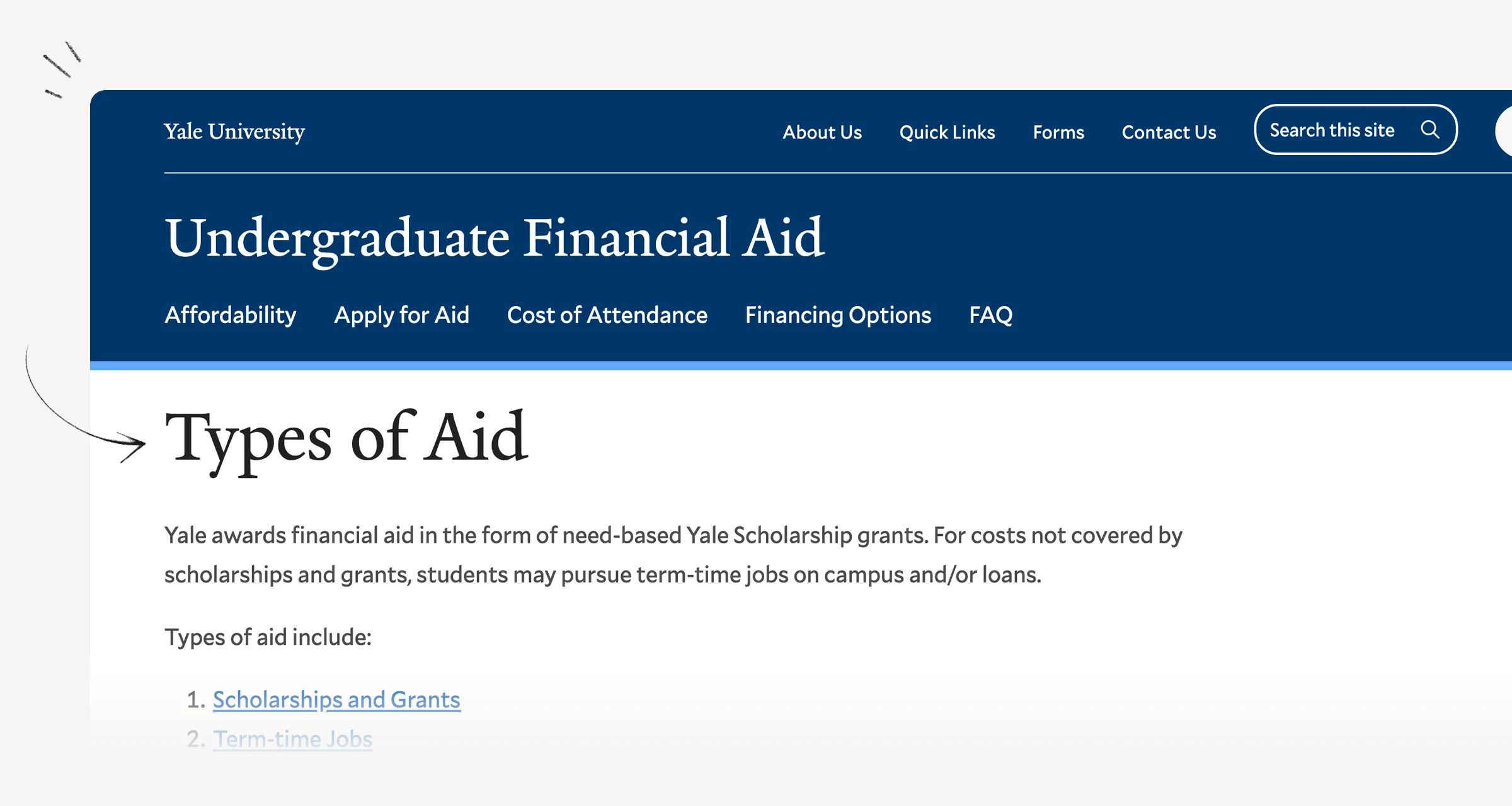
Some institutions do not offer undergraduate institutional merit scholarships at all. For example, Yale’s undergraduate aid page describes Yale Scholarship as need-based and says Yale does not offer merit-based scholarships. That statement concerns undergraduate institutional aid; it should not be generalized to every graduate program or every outside award a Yale student might receive.
Need-based aid is not a fixed family bill
Your Student Aid Index is calculated from FAFSA information and helps determine eligibility. It is not an invoice or a guaranteed aid offer. Federal Student Aid’s SAI explanation also notes that institutions and private scholarship organizations may use their own methodology for institutional aid.
The FAFSA Submission Summary contains estimates; the school determines its actual offer. Do not assume an SAI alone tells you exactly what a particular college will cost or whether every scholarship provider considers you eligible.
A hybrid-award example
Imagine an award that requires enrollment in an engineering degree, a specified academic standard, and demonstrated financial need. This is an original hypothetical award, not a real program.
A student with excellent grades might meet the academic requirement but still need to complete the financial assessment. Another student with financial need might not meet the degree requirement. The useful application checklist has three separate boxes—not one broad label reading merit or need.
Before writing an essay, list every mandatory rule, how you would prove it, and the required application route. Distinguish a requirement from a preference or selection factor using the provider’s wording.
How to pursue both without double-counting
Build two application tracks. One contains institutional and outside merit competitions; the other contains the required financial aid forms. Add hybrid awards to both tracks where appropriate, but submit only through the actual provider process.
When offers arrive, compare the full attendance budget minus confirmed grants and scholarships. Do not assume receiving a new outside merit award leaves every existing need-based item untouched. Ask the school how outside support affects its package.
An example with fictional numbers: a $32,000 attendance budget and $12,000 in confirmed gift aid produces a $20,000 net price. Whether that $12,000 is called merit, need-based, or mixed does not change the arithmetic. Renewal terms and package adjustments can change what support remains available later.
What to do next
For each school, ask whether merit review is automatic, which financial aid forms are required, whether awards are renewable, and how outside scholarships are handled. Then compare actual eligibility and net price. Labels help organize the search, but the written terms determine what you can receive and keep.