Compare the main options

Source: Academic Common Market

| Route | What it does | Eligibility check |
|---|---|---|
| Residency reclassification | May change the tuition classification under state and institution rules | Domicile, presence, dependency and required evidence; no universal one-year rule |
| WUE | Participating public colleges charge eligible nonresidents 150% or less of resident tuition | Home jurisdiction, school, major and institution-specific admission requirements |
| Academic Common Market | Eligible out-of-state programs charge in-state tuition | Participating home state and a qualifying degree unavailable at its public institutions |
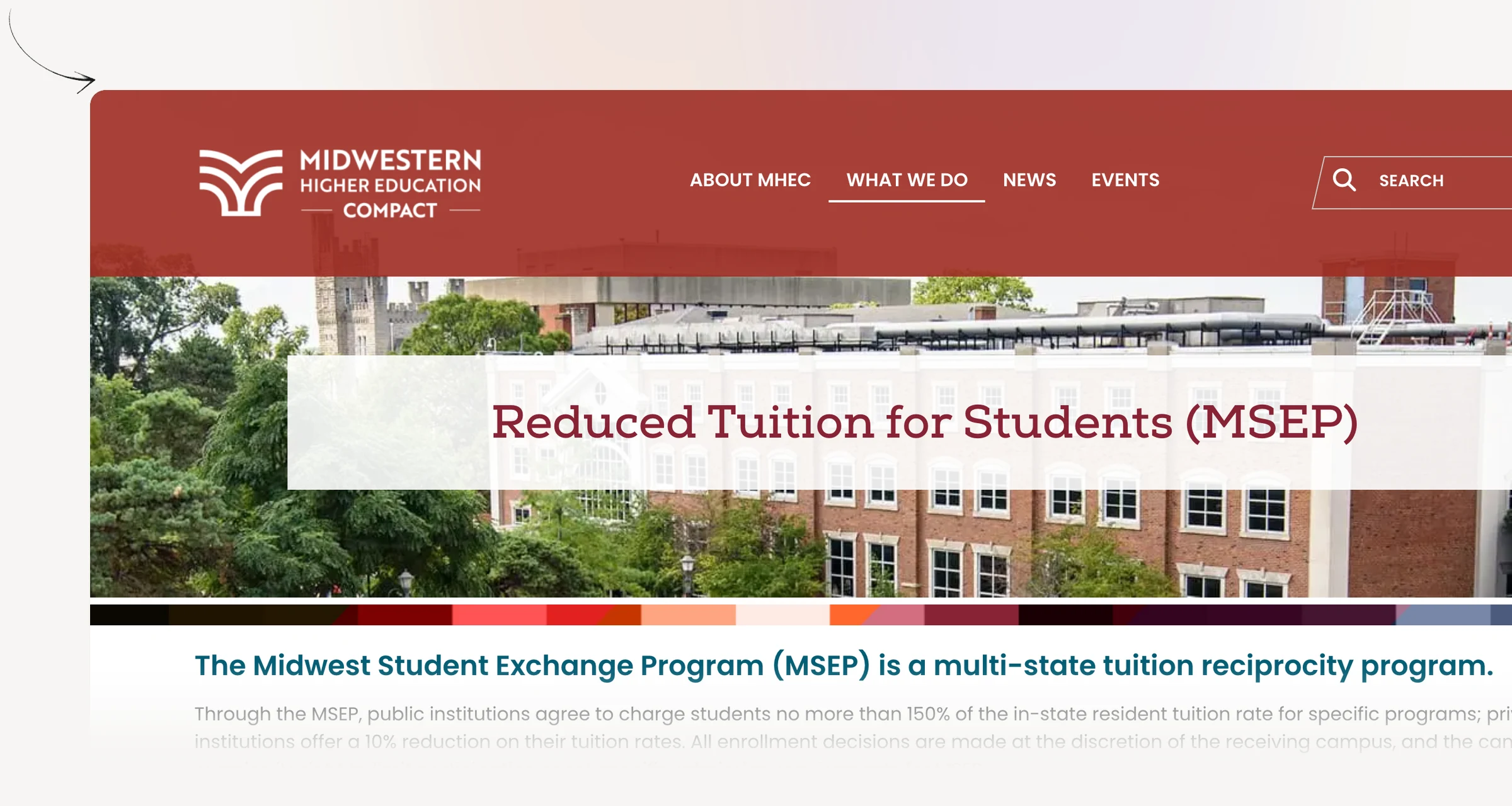
| MSEP | Participating public institutions cap specified programs at 150% of resident tuition; private institutions offer a 10% reduction | Current participating state, institution and program |
Residency: moving is not automatically enough
The University of California explicitly warns that living in California for at least 366 days alone does not establish resident tuition eligibility. Its official guidance treats time in the state as only one part of the determination. Do not interpret renting an apartment, obtaining a license or attending college there as a guaranteed conversion to in-state rates.
Ask the institution’s residency office which policy applies to your circumstances and term. Parent residence, financial dependency, a change in family circumstances and exemptions can require separate evaluation. Do not select the answer you hope is true on a residency questionnaire.
WUE: reduced nonresident tuition, not necessarily the in-state rate
Use WICHE’s participating-school list and Savings Finder to identify eligible schools and majors. WICHE does not accept applications or make WUE decisions; institutions do. Ask the school whether an additional application, priority date or competitive selection applies. A school’s presence in the directory is not a promise that every admitted student receives the rate.
Academic Common Market: verify the exact program
SREB says not every college or program participates and not every offered program is available to residents of every participating state. Start with the official program inventory. After admission to a qualifying program, apply through your home state for residency certification. SREB does not manage individual applications. Confirm the program name, campus, degree level and state approval—not just a similar-sounding major.
MSEP: check participation before calculating savings
Use the current MHEC program information rather than an old map. The reduced rate applies to specified participating options, not every Midwestern institution. Private-school percentage reductions also differ from public-school resident-rate caps.
A hypothetical cost comparison
Suppose a public institution’s resident tuition is $10,000 and its standard nonresident tuition is $25,000. A rate at 150% of resident tuition would be $15,000: lower than $25,000, but still $5,000 above resident tuition. These are invented round numbers for arithmetic, not a college’s published prices.
Then add fees, housing, meals, transport and insurance, and subtract confirmed grants. Ask whether the discount can combine with merit aid and what is required for renewal. A reduced tuition figure can still produce a higher total price than another college’s ordinary aid offer.
Questions to send the institution
“Given my home state, intended major and entry term, which reduced-tuition route applies? Is it automatic or competitive? What evidence and deadlines are required? Can it combine with other aid, and what happens if I change majors?”
Next step
Choose one route, verify it for your exact program, and compare written net-cost estimates. Keep residency classification and tuition-discount eligibility in separate columns so a savings agreement does not become a mistaken residency claim.