
The Department of Education’s information center defines net price using cost of attendance minus grant and scholarship aid, without subtracting loans. Borrowing can finance a cost; it does not make the cost disappear.

Find the real calculator
Go through the college’s official financial-aid website. The federal information center provides a calculator-address resource and explains the general requirement for institutions enrolling full-time, first-time undergraduates.
Check whom the calculator models. A transfer, graduate, part-time, or international applicant should not assume a first-year full-time calculator matches their situation. Ask financial aid for the correct tool or an individualized estimate if your category is excluded.
A six-step workflow
This is a suggested comparison method, not an application requirement.
- Choose the scenario. Record academic year, campus, residency, enrollment, housing, and meal-plan assumptions.
- Read the instructions. Use the requested income year and asset definitions; do not assume every college asks the same questions as FAFSA.
- Enter accurate information. Ask a parent or contributor to help privately when appropriate. Do not substitute a guessed income for a tax figure without labeling the uncertainty.
- Save the output. Keep the date, inputs, modeled year, cost categories, grants, and estimated net price.
- Flag exclusions. Record whether merit awards, outside scholarships, special programs, or certain family circumstances are omitted.
- Repeat consistently. Use equivalent assumptions at every school, then ask about the largest uncertainties before finalizing the college list.
Read the output before celebrating a low number
Federal Student Aid’s aid-offer guide distinguishes total costs, gift aid, and financing. Ask whether the estimate includes tuition and required fees only or also housing, food, books, transportation, and personal expenses. Costs paid outside the college can still matter to your budget.
Here is an invented two-college example:
| Annual planning figure | College A | College B |
|---|---|---|
| Total estimated cost | $40,000 | $30,000 |
| Grants and scholarships | $22,000 | $9,000 |
| Estimated net price | $18,000 | $21,000 |
| Illustrative loan offered separately | $5,000 | $5,000 |
College A has the higher sticker price but the lower net price in this example. Subtracting the loans would show cash needed after borrowing, not the net price. These figures are fictional and are not a federal loan-limit example or a real college quote.
Complex finances can require a conversation

Source: Harvard net price calculator
Harvard’s calculator instructions illustrate why institution-specific guidance matters: it gives distinct instructions for business/farm income and divorced or separated parents. Its approach should not be copied into another college’s calculator or treated as FAFSA contributor rules.
Suggested question: “Our situation includes business income/divorced parents/a recent job loss. Does your calculator handle that situation, which inputs should we use, and can your office review the estimate?”
Do not hide an unusual circumstance to make the estimated price lower. Mark it as unresolved and request the school’s instructions.
Merit awards and outside scholarships are separate checks
A calculator may model some awards and omit others. Ask whether a merit estimate is automatic or requires a separate deadline, interview, nomination, or later decision. A calculator’s scholarship line is not an award letter.
Outside scholarships can also change a package. Harvard’s published example first reduces a work expectation and then, if necessary, institutional scholarship. That is Harvard’s policy, not a universal rule. Ask each college which aid is adjusted and whether an outside award changes the amount your family is expected to provide.
Build a realistic multi-year plan
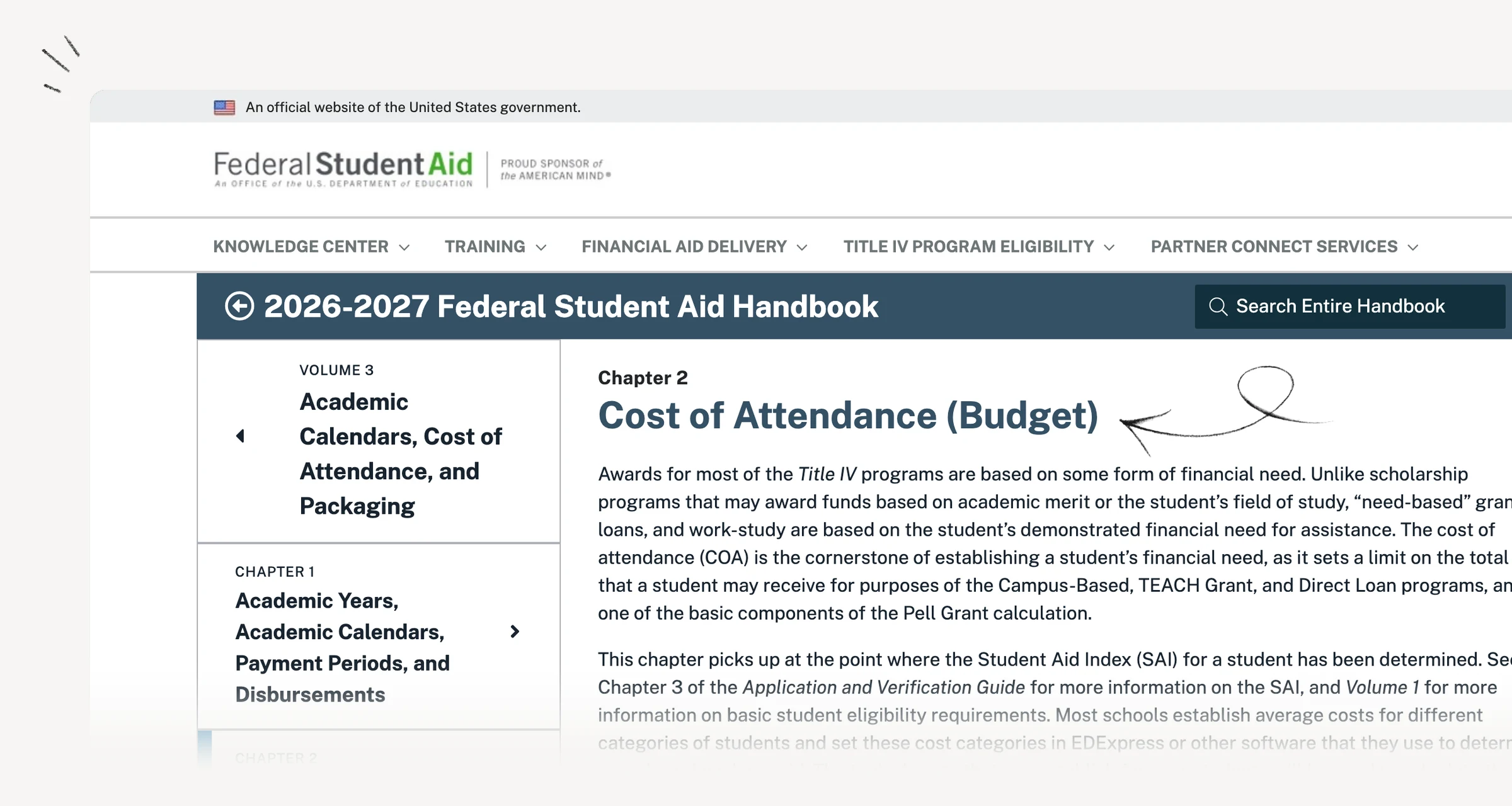
Source: Cost of attendance handbook
Use the first-year estimate as a starting point. Suggested follow-up questions:
- What renewal GPA and enrollment conditions apply to each scholarship?
- Is an award a fixed dollar amount or tied to a portion of tuition?
- Does aid change if housing, income, or enrollment changes?
- Which costs are not covered by the estimate?
Do not multiply the first-year net price by four and call it a confirmed total. Build a provisional plan with clearly labeled assumptions, then replace it with the actual award terms and current charges when available.
Your next action is to run two official calculators, save their inputs and dates, and send one focused question to each financial-aid office about the assumption that could change your decision most.