Apply to enough colleges to preserve realistic, affordable choices—but only to schools you would genuinely consider attending. There is no magic count that turns an unbalanced list into a sound plan. A smaller list with plausible alternatives can be more useful than many applications to similar highly uncertain options.
Use four tests for each school: academic fit, admission uncertainty, affordability, and application workload. The count should follow from those tests, not come first.
Start with the role of each college
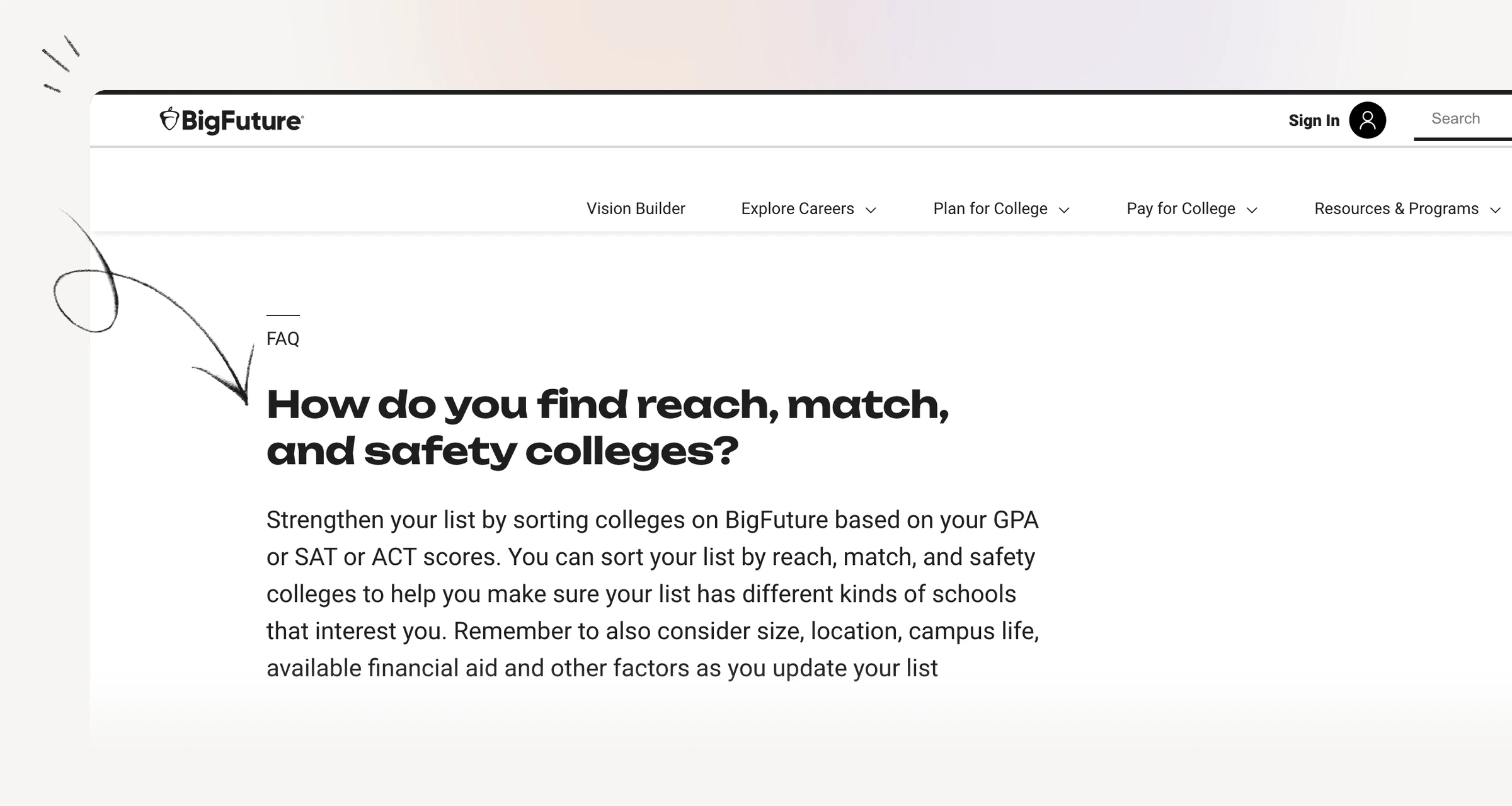
College Board’s BigFuture guidance uses reach, match, and safety categories and reminds students to consider financial aid, location, size, and campus life. Treat those labels as planning aids, not guarantees.
| List role | What to investigate | Common mistake |
|---|---|---|
| Highly uncertain option | Selectivity and any program-specific competition | Assuming a strong GPA makes admission likely |
| Plausible option | Current requirements and how your record fits the institution | Using an old admitted-student profile without context |
| More predictable option | Any explicit admission criteria and remaining conditions | Calling it safe before verifying program and cost |
| Financially workable option | Household net-price estimate and a feasible funding route | Counting on a scholarship you have not received |
A college can be academically plausible but financially uncertain. Record those uncertainties separately.
Make application effort visible
For every college, list its essays, supplements, portfolio or audition requirements, recommendations, deadlines, and any separate scholarship application. Then ask whether you can give each application careful attention.
Hypothetical: A student has eight colleges, but four require several tailored written responses and one requires a portfolio. Adding a ninth is not just another row. It adds research, drafting, revision, document coordination, and portal follow-up. A no-fee application still uses time and attention.
Conversely, several institutions may share application materials. Count actual work, not merely school names.
Estimate fees without guessing
Record the application fee listed by each institution and any additional required submission cost. Check eligible waivers before deciding a school is unaffordable to apply to.
Common App’s current fee-waiver explanation says member policies vary: some colleges do not accept its waiver, others offer their own, and eligibility can differ for international students. Confirm the college’s specific rule instead of assuming one waiver covers every situation.
Common App also provides official application-fee guidance and a way to find colleges that charge no application fee. Use provider instructions, not unverified waiver codes from a message board.
A worked list audit
Illustrative scenario, not a recommended numerical quota: Alex has seven proposed colleges. Five are highly uncertain, one lacks Alex’s intended degree, and the last has no verified affordability estimate.
Alex’s problem is not “only seven.” First, Alex removes the program mismatch. Next, Alex investigates cost and adds a college with a realistic academic and financial route. Finally, Alex compares the five uncertain choices and removes any they would not actually attend.
The resulting list may have fewer or more schools. It is stronger because each application has a defensible role.
When another application adds value
Add a college when it creates a meaningful option: a different academic route, a better-supported affordability case, a workable location, or lower uncertainty. Do not add one only because a marketing email says applying is quick.
Remove or reconsider a college when you cannot explain why you would attend, its required program is absent, a necessary cost assumption is unsupported, or the extra work would weaken more important applications.
Early-decision commitments and restrictive early-action policies can also limit combinations. Verify those rules before expanding the list.
Stop when the next application adds little
For each remaining school, write one sentence: “I would attend because __, and this application adds __ to my options.” If you cannot fill both blanks, investigate or remove it.
Your next move is to audit the existing list for academic fit and affordability, then identify the largest unresolved risk. Solving that risk is more useful than chasing a universal application count.