For-profit and nonprofit describe how an institution is controlled and how its controlling parties may be compensated. They do not, by themselves, establish whether a particular degree meets your needs. Use ownership as one comparison field, then verify the actual program, accreditation, cost, and outcomes.
The National Center for Education Statistics glossary distinguishes private nonprofit institutions from private for-profit institutions by whether the parties in control receive compensation beyond wages, rent, and other expenses for assuming risk. Public institutions are a separate control category; not every nonprofit college is a private college.
What ownership does—and does not—answer
| Question | Ownership label enough? | What to verify instead |
|---|---|---|
| Who controls the institution? | Useful starting point | Current institution record and governance information |
| Is the institution accredited? | No | Named accreditor and official current record |
| Will my credential meet a career requirement? | No | Program-specific requirements and relevant licensing authority |
| Can I transfer the credits? | No | Written receiving-college evaluation |
| What will I actually pay? | No | Comparable cost of attendance and aid offer |
| Is the schedule workable? | No | Required classes, labs, placements and attendance rules |
Avoid the shortcuts “nonprofit means affordable” and “for-profit means unaccredited.” Federal aid eligibility rules recognize public, nonprofit, and proprietary categories, subject to their respective requirements; see the Federal Student Aid Handbook. Confirm the specific institution and program rather than guessing from ownership.
Verify accreditation by exact institution and program
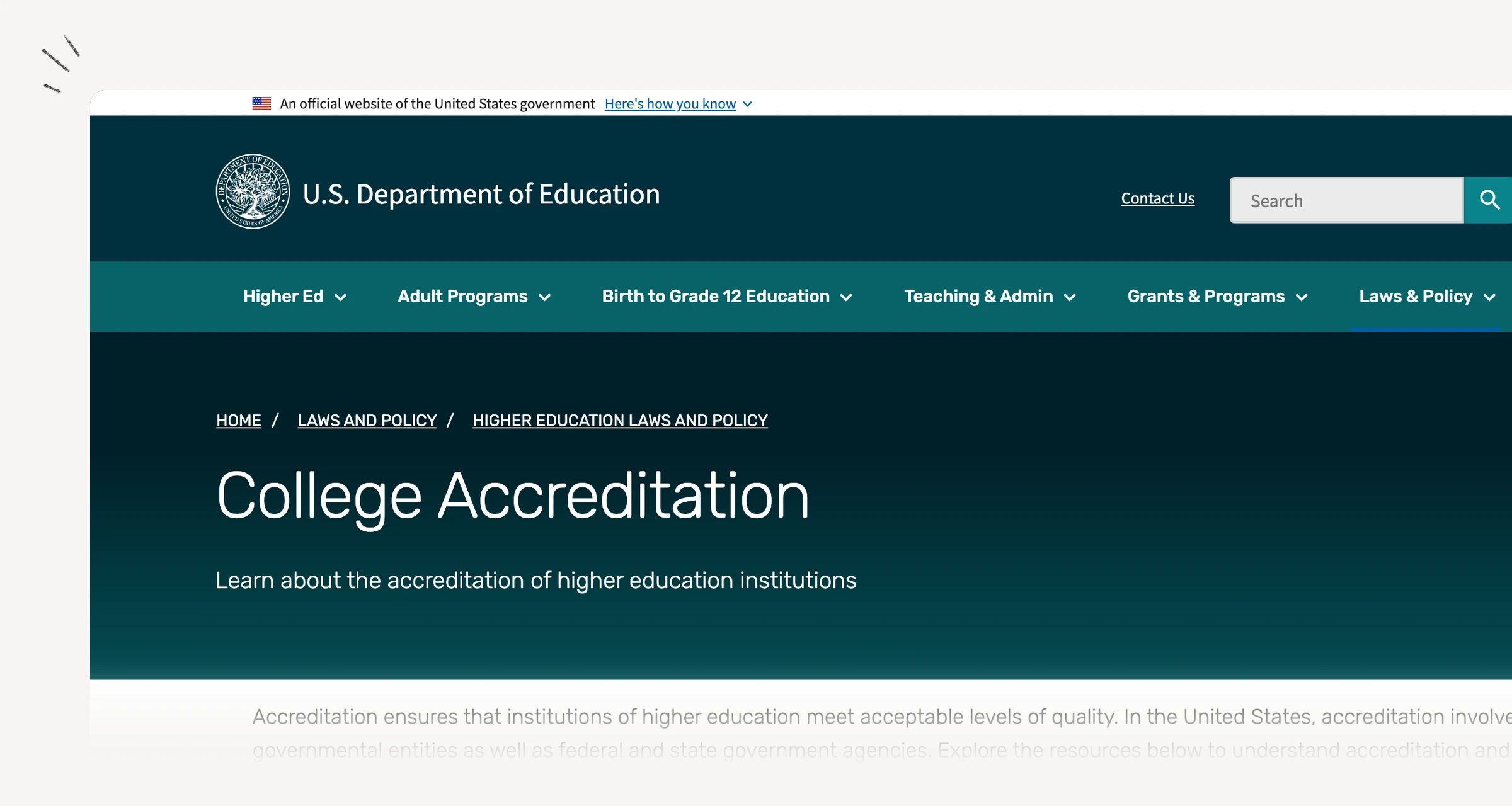
Start with the Department of Education’s college accreditation page, which links to the official accredited-institution and program database. Match the institution name, campus or location, and program where applicable. An accreditation logo in an advertisement is not the same as a current database record.
For a licensed profession, ask the relevant authority whether the exact credential and attendance route satisfy the educational requirement where you intend to work. Institutional accreditation and professional licensing eligibility are separate checks. Do not rely on a salesperson’s broad statement that a degree “works everywhere.”
Ask about transfer before you need it
If transferring is part of your plan, contact the receiving college with the course titles, syllabi, credits, and originating institution. Ask how each course would count: general credit, an elective, a major requirement, or not at all.
A statement that a school has “transfer partners” does not tell you what happens at your intended destination. Ask for the specific agreement and its conditions. Put an unanswered transfer question in your comparison sheet as a risk, not a yes.
Compare net price, not the scholarship headline
List the same costs for each option: tuition, required fees, books or supplies, living arrangements, transportation, and expenses associated with placements. Then distinguish grants and scholarships from loans and earned wages.
Federal Student Aid’s aid-offer guidance provides a framework for comparing net price and funding sources. Do not count a loan as a price reduction. If a scholarship is renewable, get its academic and enrollment conditions in writing.
A realistic comparison example
Hypothetical: A student is choosing between an accelerated career-school program and a community-college route. The accelerated option advertises earlier completion, but its required placement schedule conflicts with the student’s job. The community-college route has a different sequence and potential transfer plan.
The useful comparison is not which ownership category sounds better. It is whether the program works for the student, meets the career requirement, has a sustainable funding plan, and provides a credential or transfer route the student can verify.
Investigate outcomes without treating averages as promises
The Department of Education’s College Scorecard guidance suggests reviewing cost, graduation, debt, and earnings. Check the population and reporting period behind each figure. An institution-wide outcome may not describe your exact program, and a reported typical earning is not a guaranteed salary.
For a claimed job-placement rate, ask what counts as placement, which graduates are included, whether the job is in the field, and when it is measured. If the school will not explain the figure, do not fill the gap with an optimistic assumption.
Before paying a deposit
Save the program requirements, refund policy, full cost breakdown, award conditions, and answers to your accreditation and transfer questions. Compare at least one plausible alternative. The ownership label belongs in that file—but it should not replace the rest of it.