Common App’s first-year guide asks applicants to gather information about activities, work, and responsibilities. Yale’s admissions explanation describes activities in the context of the opportunities and commitments available to each student, including work and family obligations.

Source: Common App first-year guide
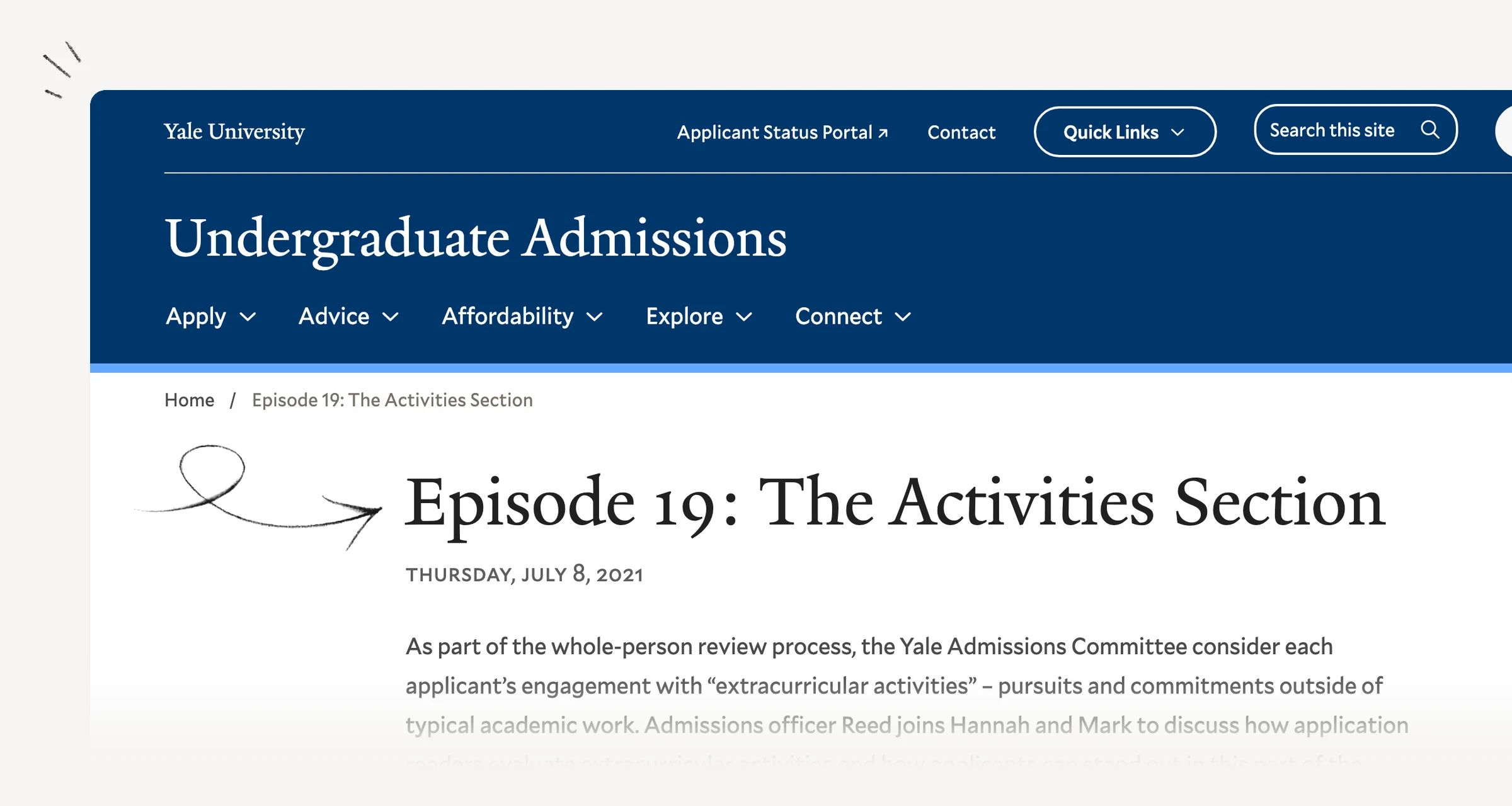
Source: Yale activities guidance
What can count?
The examples below are an editorial brainstorming tool, not a universal admissions checklist.
| Experience | Useful details to collect | Avoid describing it as |
|---|---|---|
| Paid work | Responsibilities, schedule, skills, any additional duties | A leadership position you did not hold |
| Family caregiving | Recurring tasks, time commitment, practical responsibility | A dramatic story requiring unnecessary private details |
| Sports or performing arts | Participation, practice, role, development | Only a list of trophies |
| Community service | Need addressed, actual tasks, consistency | Impact you cannot document |
| Independent project | What you made, learned, revised, or shared | A company or nonprofit that does not exist |
| Club participation | Contribution and engagement, with or without a title | A title without any explanation of work |
A hobby can be worth describing when it is meaningful to you. Yale’s activities discussion explicitly goes beyond the conventional work-club-sport list. That does not mean every casual interest needs its own application entry.
Why activities matter—and what they cannot promise
Activities help a college understand how you spend your time, what you care about, and the context of your responsibilities. Yale emphasizes students’ individual context and honest accounts of meaningful experiences. This is one college’s explanation, not a national scoring formula.
Do not assume that a particular activity, title, or number of volunteer hours guarantees admission or a scholarship. A scholarship provider may have specific service, membership, or competition requirements; read those separately rather than importing an admissions myth into an application.
Turn an activity into a clear description
Use this suggested formula: action + responsibility + specific scope or result. You do not need all three if an entry is short, but every phrase should be true.
Illustrative weak entry: “Volunteer who helped the community and developed leadership.”
Illustrative stronger entry: “Sorted pantry donations, assembled weekly grocery bags, and trained new volunteers on the inventory checklist.”
The second version tells a reader what happened. If you did not train volunteers, remove that phrase. If you use a number, retain the schedule or records that support it.
A caregiving example might read: “Provided after-school care for two younger siblings, prepared meals, and helped coordinate homework.” This communicates responsibility without disclosing diagnoses, immigration information, or other sensitive family details.
Count time honestly
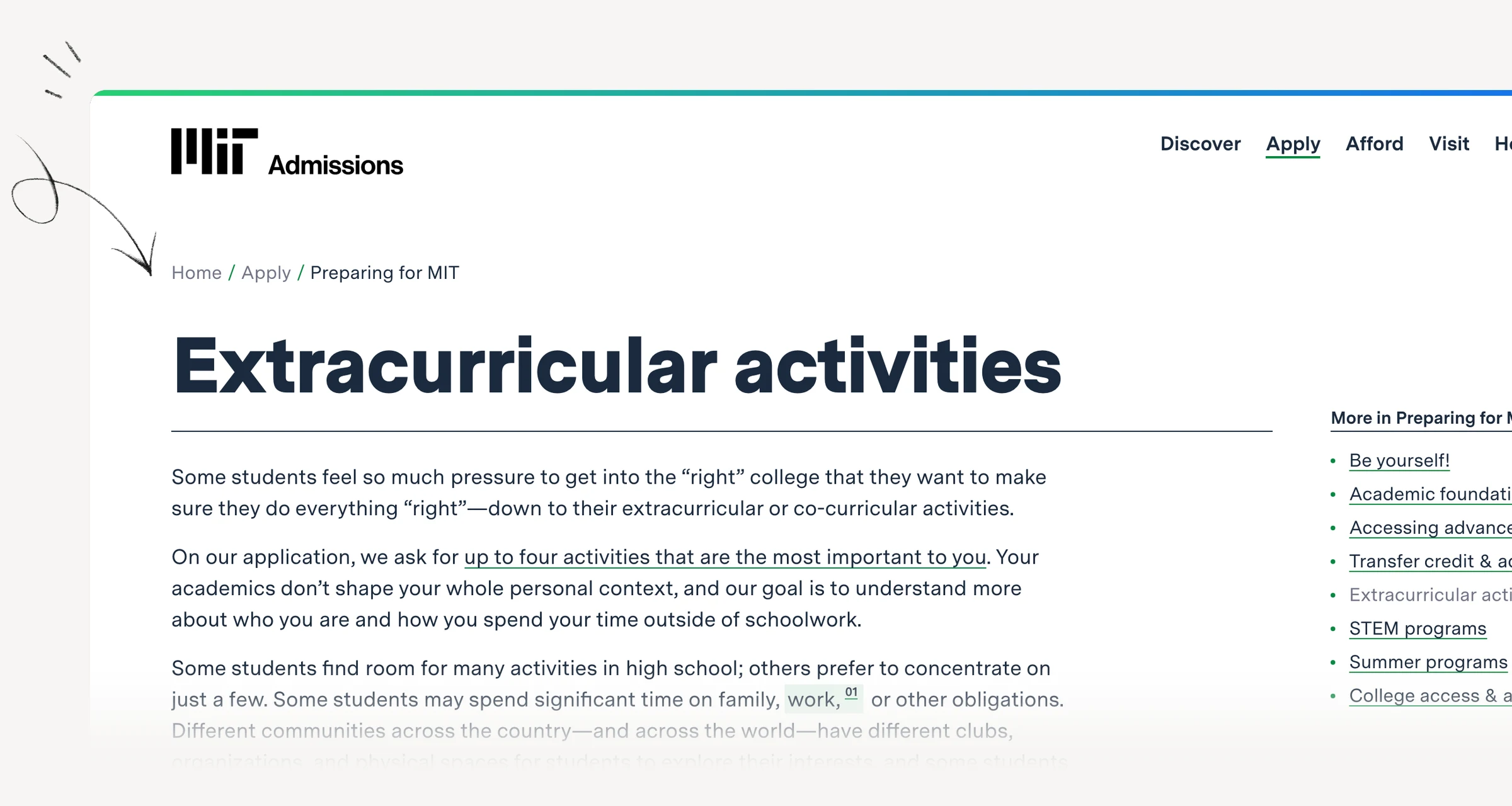
Source: MIT activities guidance
Keep a simple log or reconstruct a representative schedule. Distinguish school-year and summer participation; do not claim a year-round weekly commitment for a one-week event. Avoid counting overlapping hours twice when one project is part of a club you also list.
Follow the actual application’s fields and character limits. MIT asks for up to four activities that matter most and includes a separate place for jobs; one platform’s layout should not be copied into another. Use your live form, not an old screenshot, as the authority.
What if work or family leaves little time for clubs?
Record what you already do before adding a new commitment. Your employment or caregiving may be the most important explanation of your time outside school. Common App’s 2025–26 changes introduced additional responsibilities and circumstances prompts; check the current application for their wording rather than assuming every year is identical.
An optional sentence can explain the constraint plainly: “My weekday work schedule limits school-club participation.” You do not owe an application a trauma narrative to make ordinary responsibilities understandable.
Choose your next activity for fit, not prestige
Suggested questions:
- Would I still want to do this without listing it on an application?
- Can I participate without damaging sleep, schoolwork, or necessary work income?
- Is there useful work I can sustain rather than a title I can collect?
- Can I explain what I learned or contributed without exaggeration?
Your next step is to inventory your real commitments, choose the most meaningful ones for the specific form, and write descriptions that another person could recognize as accurate.