The University of Texas at Austin registrar describes course prerequisites as requirements students should meet before enrolling in a course. Admission requirements are separate: University of California guidance addresses high school coursework, grades, and other application conditions.
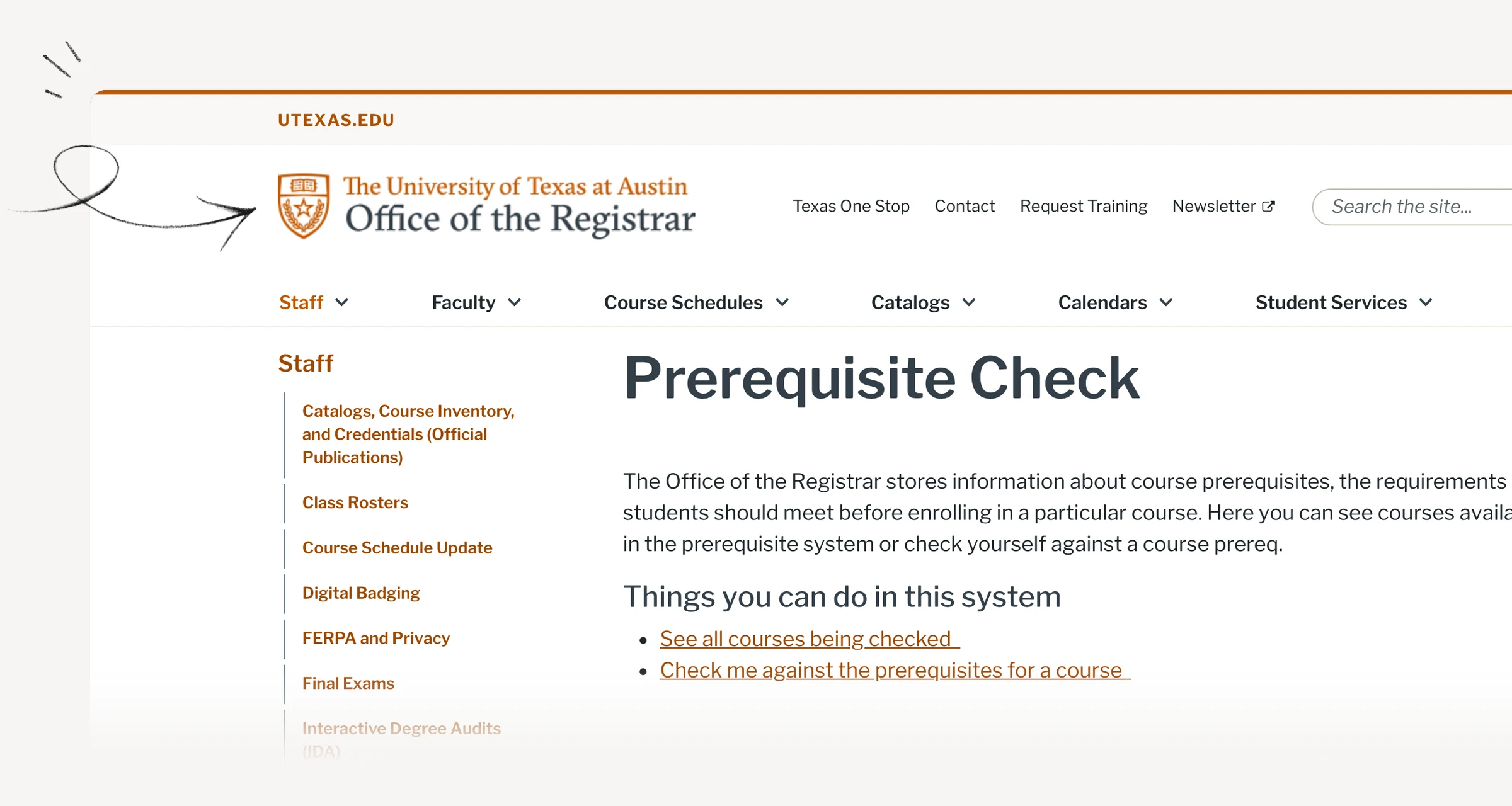
Source: UT prerequisite guidance

Source: UC admission requirements
Four terms to keep separate
| Term | How to interpret it | What to verify |
|---|---|---|
| Admission requirement | Preparation or evidence needed to apply or qualify for admission | Official admissions requirements for your applicant type |
| Course prerequisite | A condition before taking a course | Course catalog, minimum grade, equivalency, and registration enforcement |
| Corequisite | A linked requirement, often taken in the same term | Exact catalog wording; do not infer timing from the name alone |
| Recommendation | Preparation suggested rather than necessarily required | Whether the course description or department makes it mandatory |
Use these definitions as a reading guide; your college’s actual catalog controls the rule. UT’s catalog standards, for example, describe concurrent-registration language for corequisites.
Read the whole rule, including “and” and “or”
Consider this invented catalog example:
Introductory Chemistry with a grade of C or better and eligibility for College Algebra; concurrent enrollment in the chemistry laboratory required.
A student who passed chemistry with a D has completed the course but has not met this hypothetical minimum. A student who has chemistry credit but has not met math placement also has a missing requirement. The lab is a simultaneous requirement rather than evidence of a completed earlier course.
Now compare an invented alternative: “Introductory Chemistry or an approved placement score.” Either route might satisfy that line, but only if your college actually publishes those alternatives. Never invent a substitution because two subjects sound similar.
High school preparation is not a universal national list
UC’s first-year requirements provide one institution-system example, not a rule for every U.S. university. Use each college’s official admissions page and your applicant category. International, transfer, and first-year applicants can have different checklists.
Ask a counselor to compare your completed and planned courses against the specific colleges you are considering. Do not confuse meeting minimum preparation with a promise of admission: UC’s review guidance explains that selection varies by applicant pool, campus, and major.
Transfer credit can satisfy a rule only when recognized
A course may appear on your transcript without yet appearing in the new school’s prerequisite system. ASU’s override guidance asks for documentation when a prerequisite was taken elsewhere but has not been transferred. Its separate transfer-prerequisite FAQ directs students to confirm equivalency first.
Suggested email: “I am trying to register for course. I completed course at college, and the transfer guide shows equivalency. Is the credit posted, and which department reviews a prerequisite override? I can provide the transcript and syllabus.”
Do not assume that an override waives the degree requirement. Ask what the approval actually changes.
If registration blocks you
Use this troubleshooting sequence:
- Copy the exact error message and course requirement.
- Check the grade, posted transfer credit, placement, class standing, and any major restriction.
- Check whether the requirement must be completed or can be in progress.
- Contact the department’s designated advising office with documents.
- Keep an alternative course ready until approval is official.
Approval is not guaranteed. ASU’s engineering guidance illustrates a department that does not generally approve requests simply to bypass unmet prerequisites. Policies vary by department.
Plan sequences, not just individual classes
Build a suggested dependency map: Course A → Course B → Course C. Mark any minimum grades and terms in which each course is offered using your actual catalog and timetable. A missed first course can affect later options even when you have enough total credits.
Your next step is to identify one desired course or college, locate its official requirements, and list exactly which conditions are completed, in progress, or missing.