Start with the kind of fundraiser
FTC — donating through crowdfunding and fundraising platforms
| Route | Main question | Evidence to request |
|---|---|---|
| Personal campaign | Who controls the funds, and does the beneficiary know about it? | Organizer relationship, stated use, transfer arrangement |
| Charity campaign through a platform | Which legal organization receives the gift first? | Charity identity, receipt issuer, intermediary terms |
| Direct donation on a charity’s site | Have I verified the organization’s actual site? | Official donation page and confirmation |
| Organization-managed campaign | Who is responsible for accounting and donor updates? | Authorized organizer, budget, internal approval |
The FTC notes that giving to a person is not a tax-deductible charitable donation, even when that person plans to pass the money to a charity. Do not infer deductibility from the word “donation” on a checkout screen. For tax-specific questions, use current IRS guidance or a qualified adviser. FTC explanation; IRS crowdfunding guidance.
Compare fees using the actual checkout
GoFundMe’s current help page says it charges no fee to create/manage a fundraiser, but transaction fees reduce the amount transferred. Its U.S. example uses 2.9% plus $0.30 per single donation; a $50 donation yields $48.25. Optional contributions support the platform, while recurring donors pay a separate 5% fee per donation under the published terms. Do not apply the single-donation example to every country or product. GoFundMe fee rules.
GoFundMe — published fee rules and donation example
Givebutter’s published tips-enabled example shows a $100 donation, $3.30 processing fee, and $10 optional tip, totaling $113.30 if those additions are chosen. Its nonprofit guarantee says it absorbs uncovered processing/platform costs when tips are enabled; platform-fee treatment changes when tips are disabled, and auction exceptions apply. Confirm your campaign type and settings rather than advertising “free” without context. Givebutter fee settings and examples.
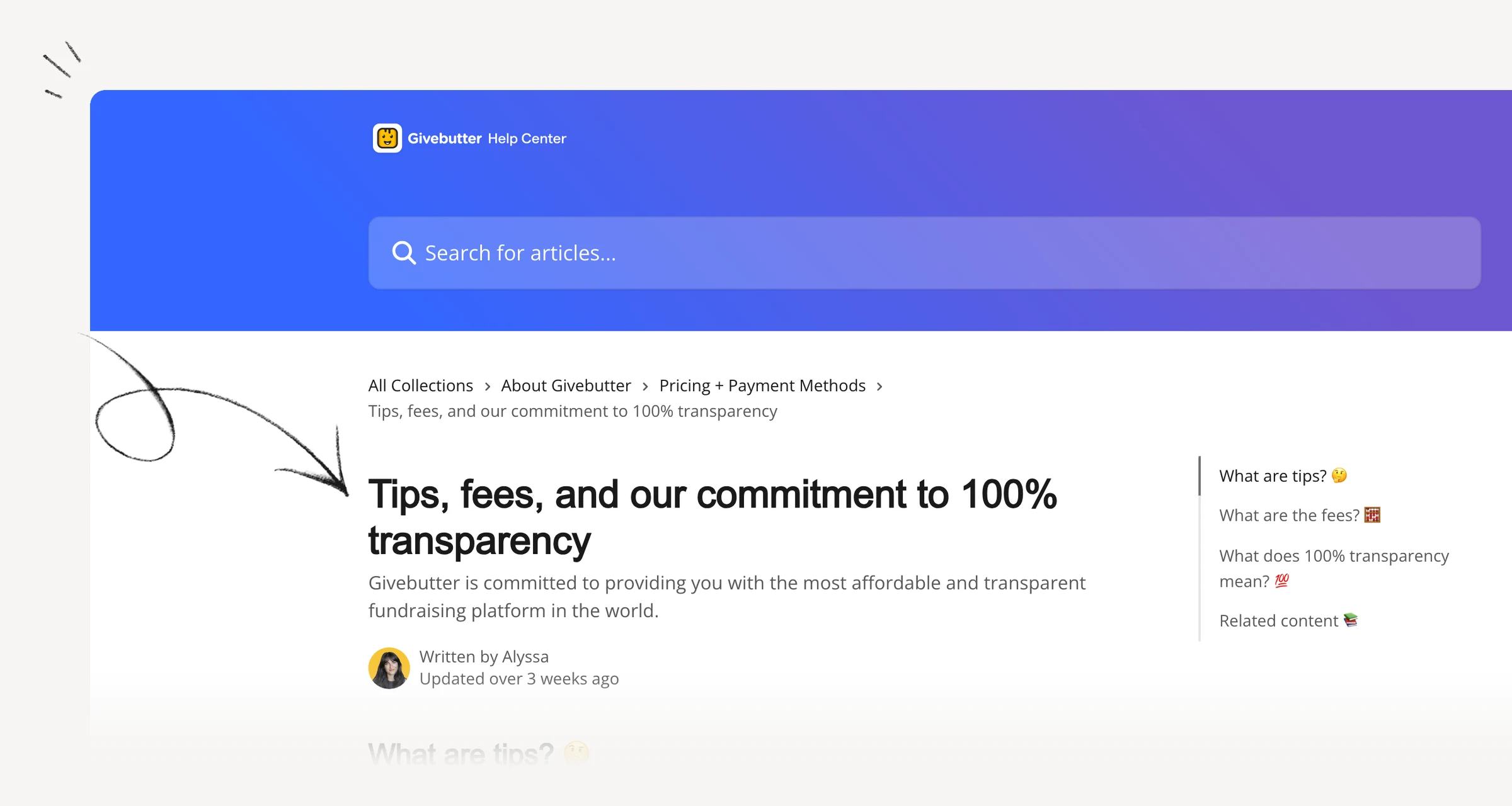
Givebutter — tips, fees, and transparency examples
These examples are checked October 13, 2026; they are not an endorsement or exhaustive platform comparison.
For organizers: prepare the fund flow before the story
Use this launch checklist:
- Name the intended beneficiary and obtain permission to tell their story.
- Write a budget separating the goal from platform costs and expected net proceeds.
- Confirm who owns the account, verifies identity, and receives withdrawals.
- Read payout timing, supported locations, refund rules, and what happens if the target is missed.
- Set a plan for surplus funds and changed circumstances.
- Test the donor view and explain optional tips accurately.
- Decide who posts updates and reconciles funds received against spending.
Illustrative goal calculation: Ten $50 single donations total $500. Using GoFundMe’s stated U.S. example, ten transfers of $48.25 total $482.50—not $500 available to spend. That calculation excludes any other situation-specific costs and is not a forecast of donations. Published example.
For donors: verify independently
Contact the beneficiary or organization through a known channel rather than only the campaign’s message button. If an organizer claims to support a charity, find the charity independently and confirm the relationship. The FTC also recommends checking whether campaign images appear elsewhere under different names and considering a direct gift through the charity’s verified site. FTC donor checks.
Avoid reposting a student’s financial or medical documents as proof. A budget and authorized explanation can be useful without making sensitive records public.
Questions to ask before proceeding
Does hitting the goal guarantee access to funds? Check payout and verification rules; a fundraising total alone is not a transfer confirmation.
Does crowdfunding replace scholarships? No. Treat a personal campaign and a scholarship application as different funding routes; this article does not promise college aid treatment or eligibility.
What is the next step? Before giving, verify the recipient and read the fee/payout policies. Before launching, document the fund flow and beneficiary permission. Pick the platform only after those questions are settled.