The best political science school for you is one where the curriculum matches your questions, required courses are accessible, and the cost is workable. This is a comparison of four documented undergraduate programs—not a national ranking, an exhaustive list, or a claim that one university is best for everyone.
Compare verified curriculum differences
| School and official program | Documented feature | Useful question to ask |
|---|---|---|
| Stanford Political Science | Majors choose primary and secondary tracks from five options, including Data Science and Justice and Law; a methods course is required | Can I combine my substantive interest with the analytical training I want? |
| UC Berkeley Political Science | Methods, history, distribution, and specialization requirements; the department specifies course-access and declaration constraints | When should I declare, and which specialization courses will be available? |
| Harvard Government | Optional curricular programs include Data Science, Tech Science, Public Policy, Political Economy, and Law and Justice | How would the concentration and an optional program fit my plan? |
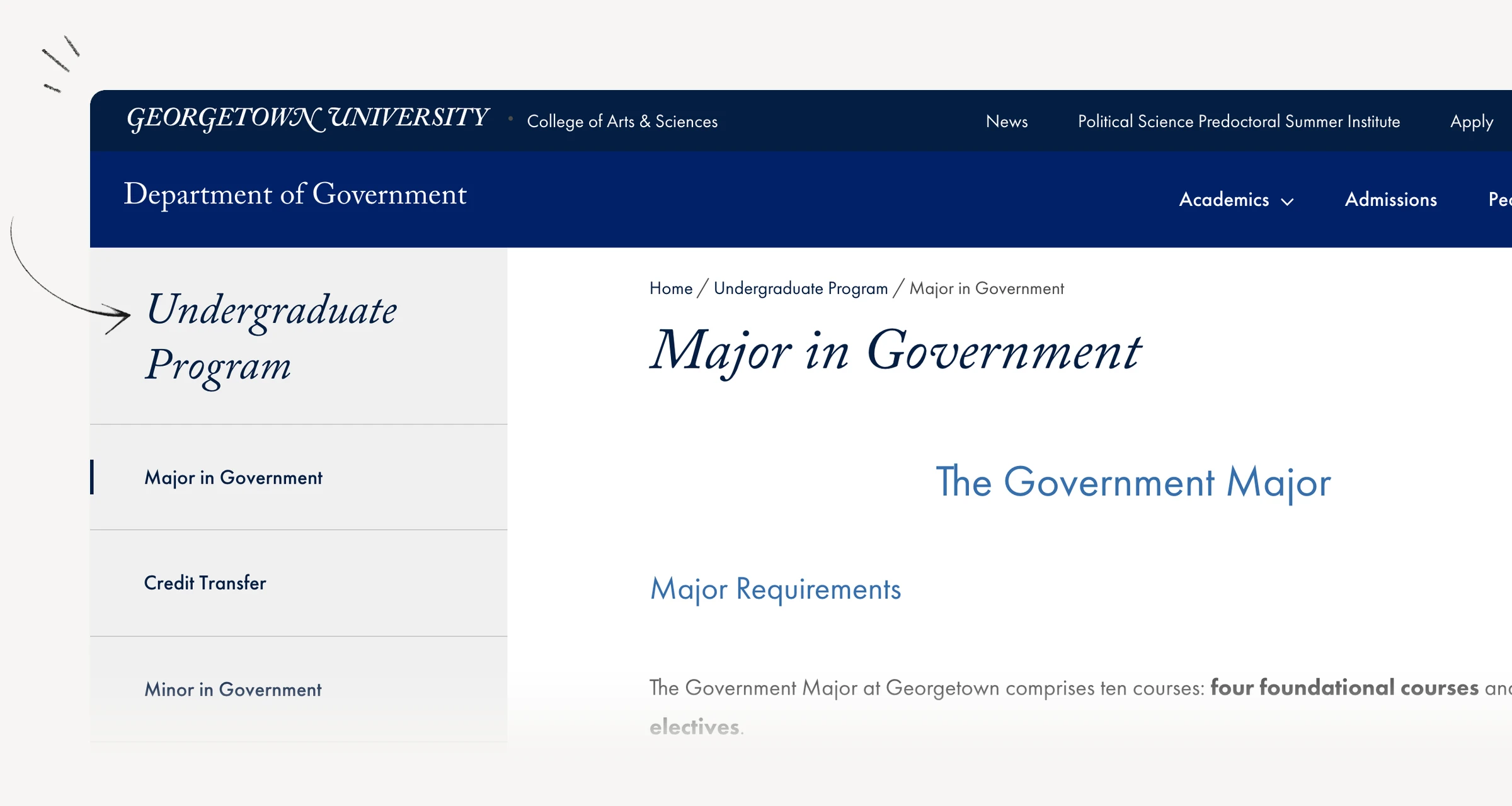
| Georgetown Government | Ten-course major: four foundations and six electives, including an upper-level theory course and departmental seminar | Which electives would give me depth rather than a disconnected collection of courses? |
“Government” and “Political Science” are different program labels in this table. Read each actual degree structure; do not assume a university’s public-policy or international-affairs program has identical requirements.
Choose a question before choosing a campus
Write down a question you want to study: how voters respond to information, how institutions change, how law and political theory intersect, or how international systems work. Then inspect the relevant department’s recent courses.
At Stanford, the Data Science track explicitly includes political data analysis, machine learning for social scientists, and causal inference. That makes it a useful program to investigate for quantitative interests; it does not mean every listed course is offered every term or every student can enroll. Stanford’s Data Science track.
At Berkeley, smaller specializations such as Public Law and Jurisprudence depend on course availability, and the department does not guarantee students can complete them. An attractive specialization label therefore needs a scheduling conversation, not just a bookmark. Berkeley major requirements.
Test access, not just the course catalog
Ask departments these questions before narrowing your list:
- Which seminars can undergraduates actually enter, and when?
- What preparation is needed for statistical or programming courses?
- How are transfer, study-abroad, or outside-department credits treated?
- Is an internship required, optional, credit-bearing, or separately funded?
- Who advises students with my intended combination of interests?
Georgetown’s major page specifies approval rules for study-abroad credit and minimum Georgetown coursework for transfer students. Berkeley restricts how outside coursework counts toward distribution and specialization. Transfer students should check these rules before assuming credits shorten the degree. Georgetown transfer and study-abroad rules; Berkeley outside-coursework rules.
Build an affordability-aware shortlist
Create a comparison sheet with curriculum fit, access questions, estimated net cost, travel and housing assumptions, and unresolved requirements. Use each college’s own net-price calculator and financial-aid materials; this article does not claim that private universities are always more expensive or that public universities always cost less for your household.
Illustrative planning example: A student interested in election analysis compares methods requirements and relevant electives, then asks whether those courses fit a transfer schedule. A second student interested in political theory gives more weight to seminar options and writing opportunities. Neither needs an invented numerical ranking to make a useful shortlist.
Questions to settle before applying
Which of these is number one? This article does not assign ranks. Its selection is a research starting point, not evidence of overall superiority.
Do these programs guarantee law-school admission or a political career? No outcome guarantee is made here. Compare the education itself and seek current career information directly from the institution.
What is my next step? Choose two programs, read the degree requirements, identify one relevant recent course, and send the same access-and-credit questions to both departments. Include at least one affordable option outside this example list.