A useful environmental-college comparison begins with what you want to learn: laboratory and field methods, data analysis, policy, or a combination. Similar degree names do not guarantee the same preparation.
The four examples below have verified official program descriptions. They are a starting shortlist—not a national ranking, a guarantee of employment or proof that other colleges offer weaker programs.
Compare the academic structure
| Institution | Exact program example | Documented distinction | Official source |
|---|---|---|---|
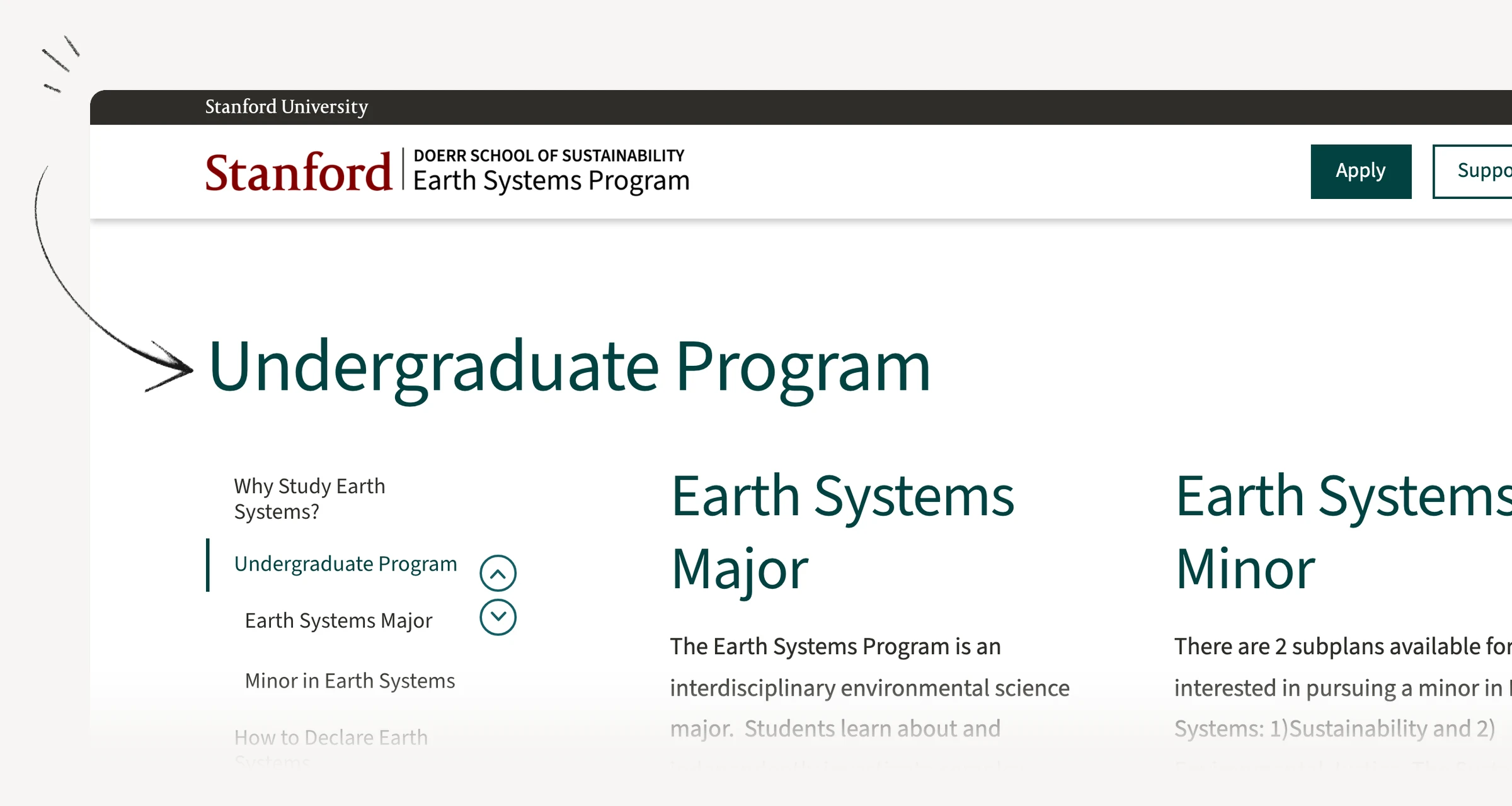
| Stanford | Earth Systems | Interdisciplinary environmental science integrating science, economics and policy | Undergraduate program |
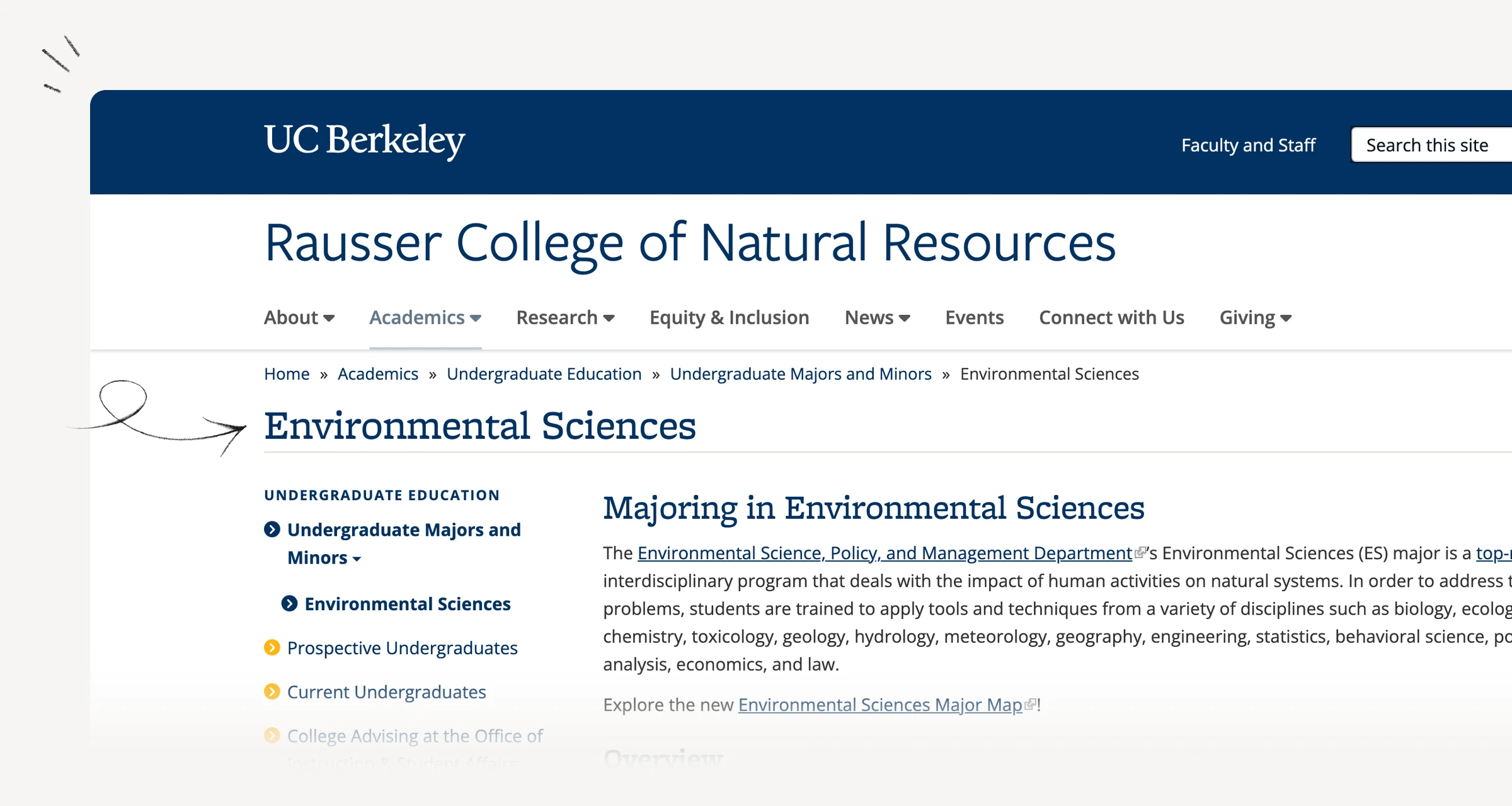
| UC Berkeley | Environmental Sciences | Three concentrations and a year-long senior research thesis | Major guide |
| Harvard | Environmental Science and Public Policy | Scientific issues studied alongside economic, legal, political and social dimensions | Concentration |
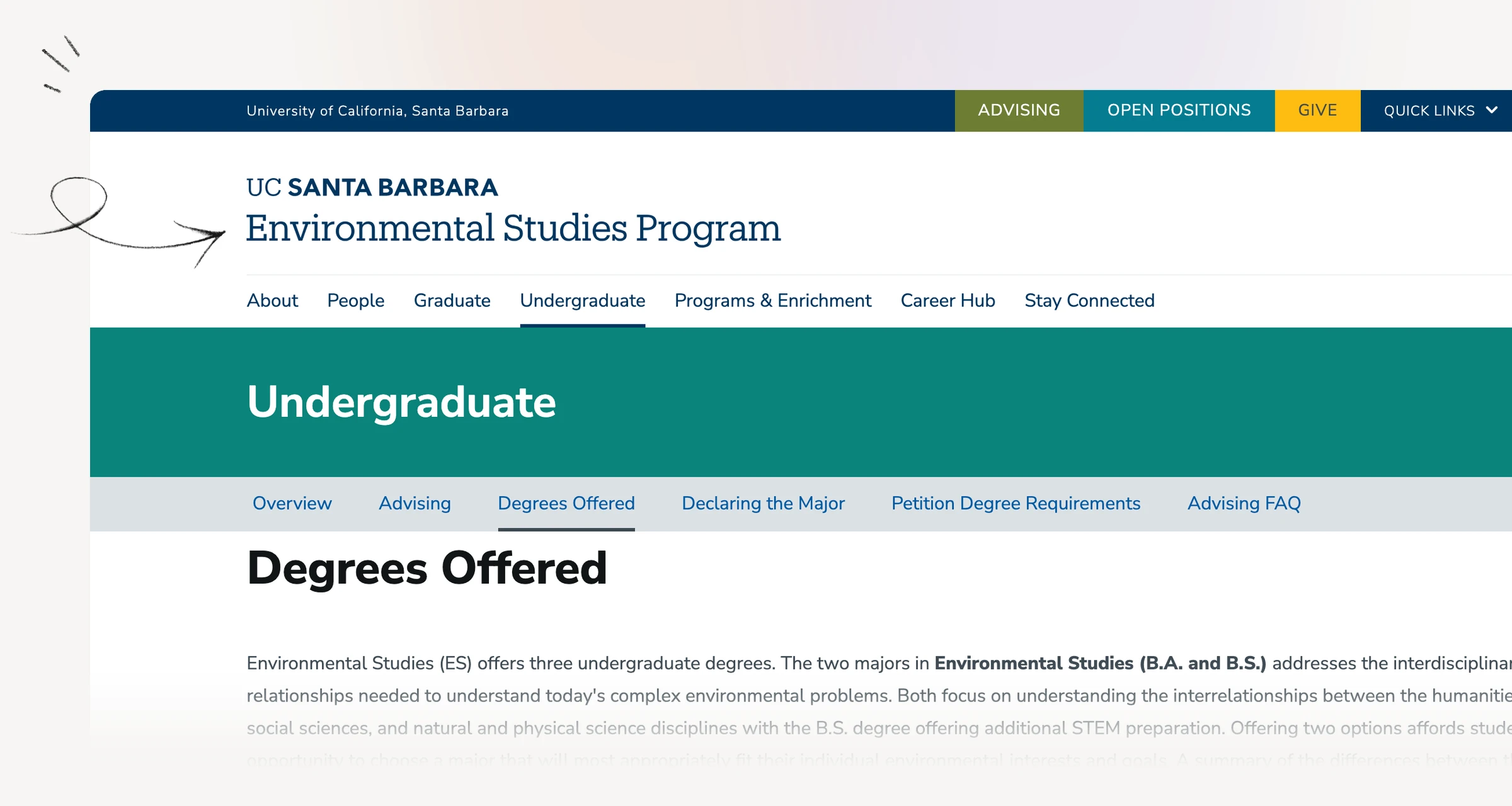
| UC Santa Barbara | Environmental Studies BA/BS; Hydrological Sciences and Policy BS | Environmental Studies BS adds STEM preparation; a separate water-focused degree exists | Degree comparison |
Features checked October 13, 2026. “Earth Systems,” “Environmental Studies” and “Environmental Science and Public Policy” are not silently renamed as identical environmental-science degrees.
Stanford: map a broad interest to an actual pathway
Stanford’s Earth Systems overview identifies interdisciplinary environmental-science study and links to academic tracks, an internship, honors and capstone information. Follow those links to explore the specific route that fits your goals.
Ask how the chosen track changes quantitative preparation, electives and the culminating experience. A broad program can be useful, but your final course plan should still show the skills you intend to develop. No internship placement or specific supervisor is guaranteed by the existence of a program page.
Berkeley: plan backward from the research sequence
Berkeley’s Environmental Sciences guide identifies biological, social and physical science concentrations. It also gives a prerequisite chain: upper-division statistics precedes research methods, and research methods precedes the senior research seminar sequence.
That sequence is especially important for transfer students or anyone considering a late major change. Ask an adviser to map prerequisites and term availability before assuming you can fit the thesis into the last semester.
Use the senior project as a comparison question: will you formulate a research question, choose methods, carry out analysis and communicate results? Ask how advisers and resources are arranged rather than assuming independent research means working without support.
Harvard: investigate the science-and-policy balance
Harvard’s ESPP concentration page explains a multidisciplinary approach to environmental problems. If you want to understand policy alongside science, compare the current requirements with programs that emphasize a different balance.
Ask which scientific and analytical courses you would take and how a focus area affects your plan. Do not infer that this concentration is interchangeable with environmental engineering or that its title guarantees preparation for a particular technical role.
UCSB: compare BA and BS directly
UCSB’s degree guide states that the Environmental Studies BS includes additional science preparation, including statistics, calculus and introductory biology, chemistry and physics. Its BA also has interdisciplinary requirements; it is not accurately described as containing no science.
Compare both degree worksheets for your applicable year. Students interested in water systems should also inspect the separately named Hydrological Sciences and Policy BS, rather than assuming it is simply another name for Environmental Studies.
Turn a career interest into a course comparison
An original hypothetical example: Priya wants to study water quality. She lists the preparation she wants—chemistry, statistics, field sampling and a research project—then asks each program where those skills appear in its current curriculum. She treats “strong sustainability reputation” as insufficient evidence of that specific preparation.
Your worksheet can have five rows: foundational science, quantitative methods, field/laboratory work, policy/social context, and capstone or thesis. Fill it with course requirements and adviser answers, not assumptions based on BA or BS alone.
Compare the financial plan separately
Use actual total attendance costs and confirmed grants and scholarships to compare net price. Keep loans distinct from price reductions. Federal Student Aid’s offer guide explains the method.
Also ask about extra costs for required field courses, equipment or off-campus study. This article does not assume those charges exist at every program or quote unverified amounts. A program that fits academically still needs a sustainable funding plan.
Your next move
Choose two programs and obtain their current requirements. Ask an adviser to identify the route from your starting coursework to your preferred research or capstone experience. Then compare actual financial-aid offers before committing.