
This is an unranked, editorially selected comparison of documented pathways, not a claim that these are the six highest-ranked schools. Program facts were checked October 13, 2026. No current acceptance rate, salary or tuition figure is invented.
Compare six architecture colleges

| College and official program | Undergraduate route | Documented distinction | Question to resolve before applying |
|---|---|---|---|
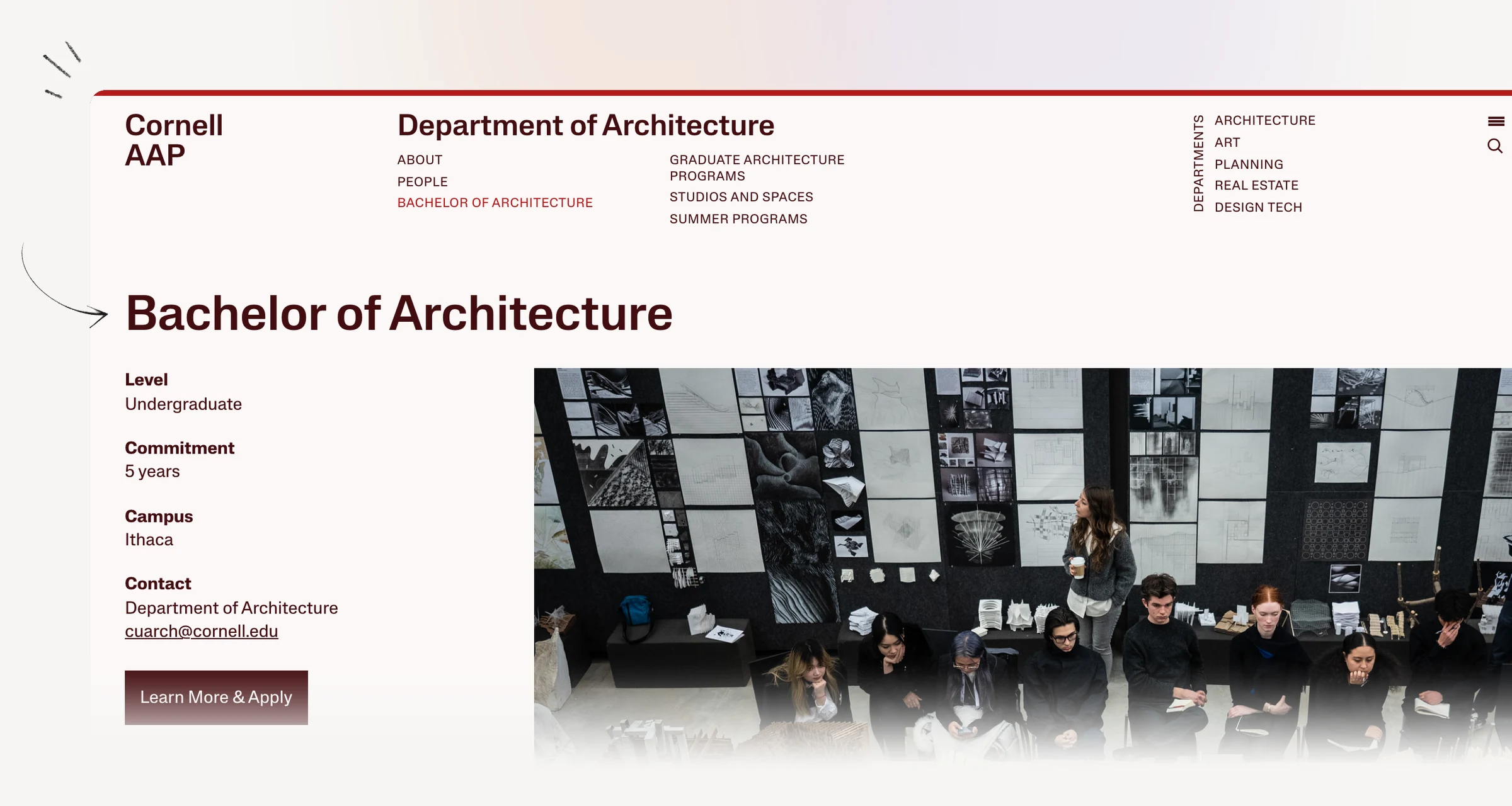
| Cornell University | Five-year NAAB-accredited B.Arch. | Design alongside theory, technology, structures and representation; Rome/NYC study options | How do architecture-specific application requirements fit your preparation? |
| Cal Poly, San Luis Obispo | Five-year NAAB-accredited B.Arch. | Lab-oriented, sequential design/technology program; fifth-year extended project | Will transfer credit change studio placement, not merely credit totals? |
| Virginia Tech | Five-year NAAB-accredited B.Arch. | Common first-year Foundation Program; arts/sciences and building-design research | Which labs and later-year opportunities match your interests? |
| Rice University | Four-year B.A., then two-year B.Arch. stage including practice year | Paid mentored Preceptorship; entry to B.Arch. stage requires application and portfolio | What are progression conditions and the full cost across both stages? |
| Syracuse University | Five-year professional B.Arch. | Separate architecture portfolio review alongside university application | What are this cycle’s portfolio format and deadline? |
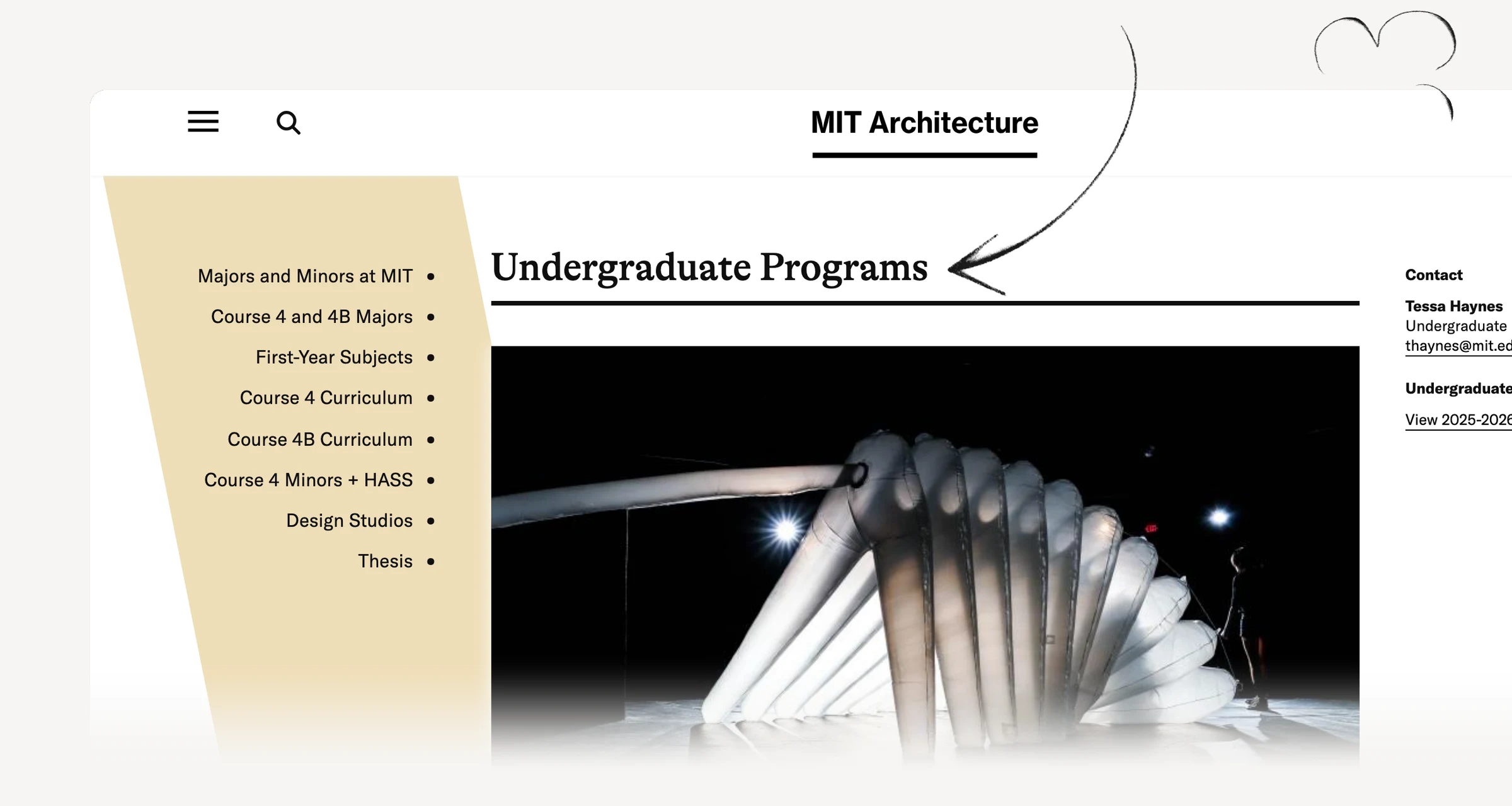
| MIT | B.S. in Architecture; preprofessional | Building technology, computation, design and architectural history/theory | If seeking licensure, what later professional education will you pursue? |
The comparison is based on primary program and catalog sources, not recycled ranking claims.
Professional degree versus preprofessional degree
A NAAB-accredited B.Arch. can satisfy the education component for many U.S. licensure routes; it does not award an architecture license by itself. Licensure is set by the relevant state or territory and generally combines education, experience and examination. Some jurisdictions have alternatives to an accredited degree.
A B.A. or B.S. in architecture is not the same credential as an accredited professional B.Arch. A student may later complete a professional M.Arch., but program length and admission depend on prior education and the receiving institution. Do not assume every undergraduate architecture degree is followed by the same two-year master’s.
Use NAAB’s program directory to check the exact degree and accreditation status—not just the university name. Review NCARB’s licensure guidance for the jurisdiction where you plan to practice.
Which documented pathway matches your priorities?
A direct professional undergraduate route
Start a comparison among Cornell, Cal Poly, Virginia Tech and Syracuse if your priority is a professional undergraduate architecture degree. This is a pathway match, not a judgment that these schools are equally affordable or equally accessible.
Their differences deserve closer inspection:
- Cornell describes a core first-three-year curriculum followed by opportunities to work across disciplines and choose concentrations. About a quarter of coursework takes place outside architecture.
- Cal Poly describes a sequential, lab-oriented approach and a fifth-year research/design project and exhibit. Its setting includes allied built-environment disciplines.
- Virginia Tech begins with a shared Foundation Program and describes work across building science, materials, computation, fabrication and broader design questions.
- Syracuse requires both a university application and a creative portfolio. Its architecture portfolio instructions should be checked separately from a general admissions calendar.
Suggested next step: Open the curriculum and review the first-year sequence, electives and final-year requirements. Ask for sample studio briefs rather than choosing solely from building photographs or promotional awards.
Structured practice inside the degree sequence
Rice is distinctive because its professional route includes a mentored paid Preceptorship. The B.Arch. follows its B.A. in architecture, and progression requires completion of B.A. requirements, a portfolio and formal application. Rice also describes a separate architectural-studies option that does not lead to a professional degree.
Suggested next step: Ask how practice placements, progression decisions and financial aid work across the full sequence. Do not compare it with a five-year program using only the number of calendar years.
Architecture alongside a broader technical education
MIT’s B.S. in Architecture connects design with technology, computation and history/theory. Its catalog explicitly calls the degree preprofessional. MIT also offers a separate B.S. in Art and Design; the names should not be treated as interchangeable.
Suggested next step: If licensure is your goal, include the likely next professional degree in your academic and funding plan before deciding a four-year bachelor’s is the entire pathway.
Compare total pathway cost, not just one year’s tuition
Build a budget with these separate lines:
- Tuition and mandatory fees for every expected stage.
- Housing, food and transportation.
- Required studio materials, fabrication, printing and equipment.
- Study-away costs where relevant.
- Confirmed renewable grants, not hoped-for awards.
- Any additional professional degree you plan to pursue.
Use each school’s current official cost and aid information. Rice’s program page still labels its embedded expense table 2024–25, so those numbers are deliberately not republished here as current costs.
Illustrative decision: One student wants a professional undergraduate credential and compares B.Arch. programs. Another wants to explore computation and design before committing to a later M.Arch. Their best-fit shortlists can differ without either needing a national ranking to justify the choice.
Transfers and portfolios need an extra check
Cornell’s catalog warns that architecture transfers may lose standing because of curriculum specificity and sequencing. Accepted general credits do not automatically establish advanced studio placement.
For any transfer option, ask: “Which studio will I enter, which requirements remain, and what is my expected professional-degree completion sequence?” Request the answer before comparing costs.
For portfolio preparation, inventory your own work and the role you played in collaborative projects. Follow each school’s current instructions; do not assume one file, page count or deadline works everywhere. Syracuse publishes a dedicated requirements page.
Your next move: Choose a professional or preprofessional route, select three program comparisons, then verify admission requirements, degree progression and your full-pathway net cost.