| School | Verified program option | A useful fit question | Official program information |
|---|---|---|---|
| University of Texas at Austin, McCombs | Accounting BBA; integrated BBA/MPA route for current McCombs students | Do you want to plan for a combined undergraduate and graduate accounting pathway? | McCombs accounting degrees |
| University of Illinois Urbana-Champaign, Gies | BS in Accountancy; accounting master’s options with different applicant backgrounds | Which undergraduate curriculum and later master’s route fit your prior education? | BS requirements |
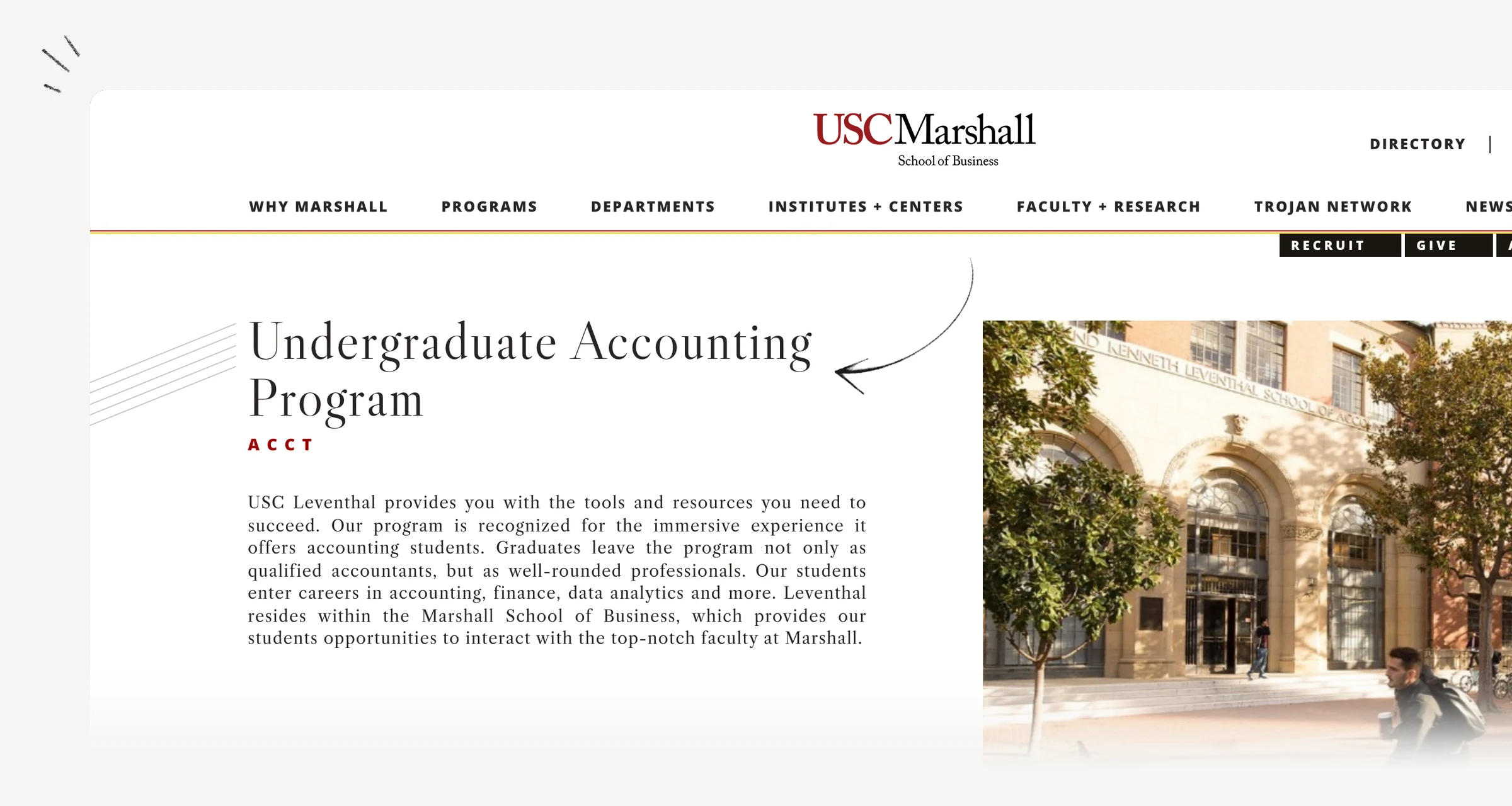
| University of Southern California, Leventhal | BS in Accounting within the Marshall school | Do you want a dedicated accounting degree rather than a general business major? | Leventhal BS Accounting |
Texas McCombs: examine the integrated pathway

Source: Read the integrated MPA overview
McCombs describes its integrated Master in Professional Accounting as a five-year pathway to a BBA in accounting and an MPA for its undergraduates. The program’s undergraduate page directs students to apply at the end of sophomore year and follow the accounting plan first. This is not an automatic master’s offer attached to freshman admission. Read the integrated MPA overview.
Next step: Ask an adviser how undergraduate course sequencing, program admission, graduate tuition, and financial aid would work for you. Compare the combined route with stopping after the bachelor’s degree rather than assuming another year is necessary.
Illinois Gies: distinguish the bachelor’s degree from master’s admissions
Gies publishes a BS in Accountancy planning page with catalog-year-specific plans. Its major coursework is completed alongside general-education and business-core requirements. The page tells students to confirm requirements using their degree audit and current course offerings. See the BS planning resources.
The college also distinguishes its master’s options. The Master of Accounting Science is designed for accounting graduates; the Master of Science in Accountancy is a separate route. A similar program name does not mean identical eligibility. Compare Gies accounting graduate programs.
Next step: Download the correct entering-year plan and ask how transfer credit, internship scheduling, and a later graduate application would affect your sequence.
USC Leventhal: evaluate a dedicated accounting curriculum
USC offers a BS in Accounting through Leventhal within Marshall. Its advising page identifies a 128-unit minimum, alongside university and major requirements, and points accounting students toward school scholarship opportunities. It does not promise that every applicant will receive an award. Review USC accounting advising information.
Next step: Compare accounting with business administration in the current catalog. Ask which accounting courses, student organizations, and career services are available at your stage—and whether a school scholarship needs a separate application.
Do not assume one nationwide CPA rule
Choosing a degree and qualifying for CPA licensure are separate decisions. Education and experience rules vary by jurisdiction, and new licensure pathways have different effective dates. NASBA’s pathways tracker is a starting point; the applicable state board’s current rules control. Avoid the blanket claim that every future CPA must earn exactly 150 credits or a master’s degree.
Ask each program: “For the jurisdiction where I expect to practice, which accounting, business, ethics, education, and experience requirements would this plan satisfy—and which would remain?” Get a course-level answer rather than a marketing label.
Compare total pathway cost
Build a worksheet with tuition and living costs for each year, confirmed grants and scholarships, any extra study, and the conditions for renewing aid. Keep borrowing separate from gift aid. Request current cost information directly; this article does not supply unverified tuition figures.
Hypothetical example: A student comparing a bachelor’s route and a combined bachelor’s/master’s route should compare the full educational sequence—not four years at one school against five at another while ignoring the additional degree. If the state’s available pathway differs, revisit the plan before committing to extra coursework.
Your next move
Source: Leventhal BS Accounting
Shortlist programs whose published course plans fit your interests. Then obtain a school-specific cost estimate, confirm the route into the major, and check the state board’s requirements. A famous program is a candidate to investigate, not a substitute for those answers.