Choose between the ACT and SAT using your colleges’ testing rules and your performance on current official practice tests. Neither a friend’s preference nor a label such as “science person” tells you which test will work better for you. Your decision should account for timing, question design, preparation needs, and the requirements of your actual college list.
Compare today’s formats, not an old prep book
| Standard format | Digital SAT | Enhanced ACT core test |
|---|---|---|
| Sections | Reading and Writing; Math | English; Math; Reading |
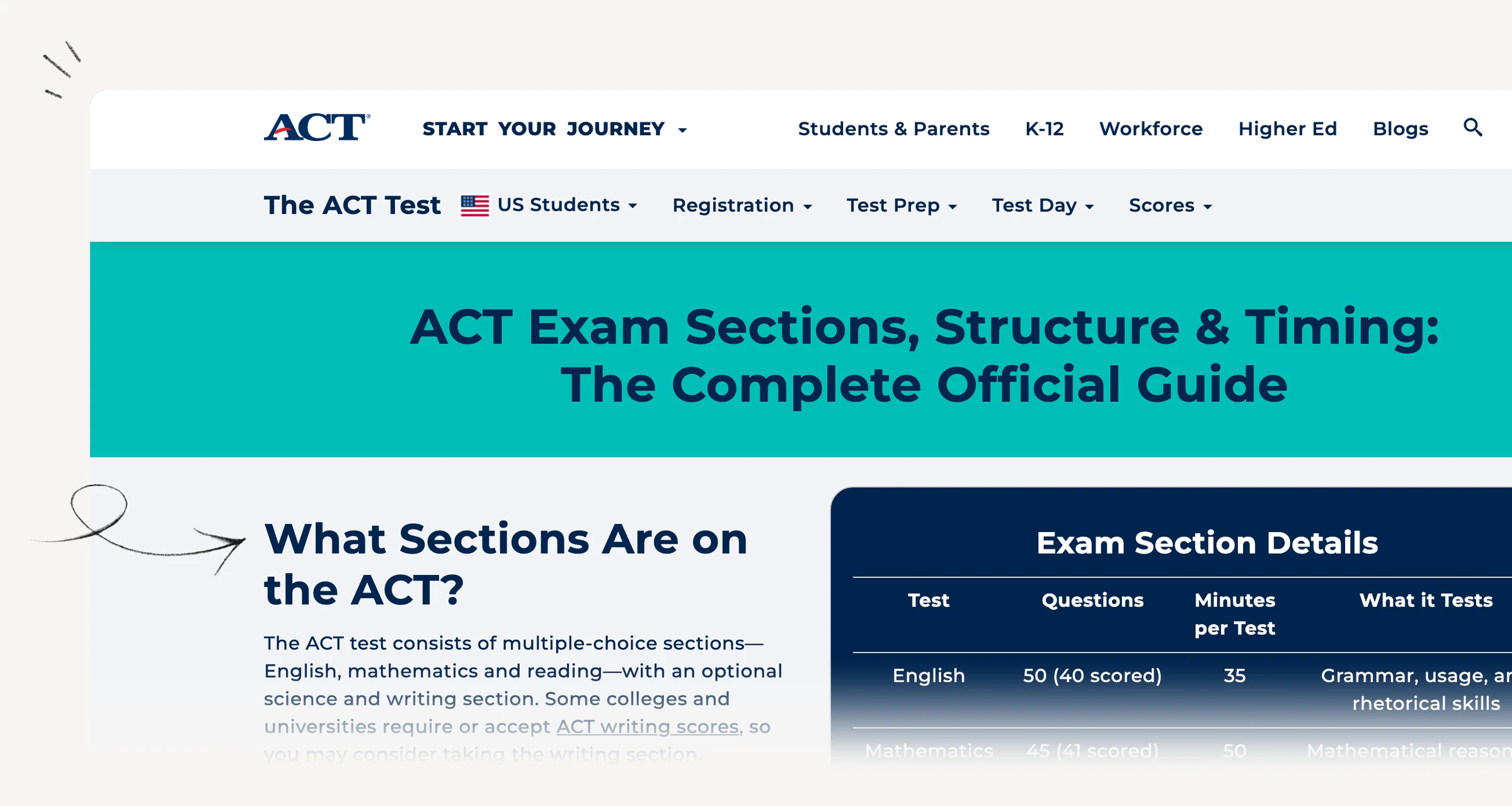
| Questions | 98 total | 131 total |
| Timed testing, excluding breaks | 134 minutes | 125 minutes |
| Optional additions | Check the administration’s rules | Science and Writing |
| Core structure | Two modules in each section | Three core subject sections |
These figures come from College Board’s SAT structure guide and ACT’s section guide. They describe standard timing, not accommodations or the total time you will spend at the test center. Do not use College Board’s older relative-speed marketing comparison to evaluate the enhanced ACT; compare the current absolute timings instead.
ACT’s enhanced core composite is based on English, Math, and Reading. Science optionality for a state or district administration can be determined at the contract level rather than by an individual student. Review ACT’s enhancement guidance before assuming your school-day test permits you to omit Science.
Start with a college-policy worksheet
Create one row for each college and verify the policy for your entry year on that college’s admissions site. Record:
- Whether testing is required, optional, or not considered
- Which tests and optional sections the institution accepts or requires
- Whether self-reported scores are sufficient initially
- Whether superscoring is permitted
- The last accepted testing date for your application round
- Any separate scholarship or program testing rule
Leave an uncertain field marked “confirm,” not “probably optional.” A college-level rule and a named scholarship’s rule are separate questions. A provider’s test design does not determine an institution’s admission policy.
Run a fair practice comparison
Use a full-length digital SAT practice test and a current enhanced ACT practice test. Choose the same level of help for both: none during timed work. Use approved tools, planned breaks, and conditions that resemble the administration you intend to take. Check the version before starting; a legacy ACT with different section lengths is not a fair timing comparison. ACT explains the enhanced format and practice resources in its official FAQ.
Record more than the total score. After each section, classify missed questions as:
- Content: you did not know the underlying concept
- Interpretation: you knew the material but misunderstood the question
- Timing: you could solve it after time expired
- Execution: you made an avoidable calculation or selection error
This diagnostic is an editorial decision aid, not a prediction of admission or a scoring conversion.
Example: use the error pattern to choose a preparation plan
Hypothetical: Maya finishes the SAT math modules but repeatedly misses linear-equation questions. On the ACT, her math content is stronger, but she runs out of time during reading. Her first move is not to declare one exam easier. She reviews algebra for one route and tests a reading-pacing strategy for the other, then compares fresh practice results.
If one route shows a repeatable advantage and meets her colleges’ requirements, she focuses there. If both remain similar, registration logistics, available dates, and the amount of preparation she can realistically sustain become useful tie-breakers. The larger-looking raw score is not a tie-breaker because the tests use different scales.
Do you need to take both official tests?
Not simply because both exist. Taking two practice tests creates information; paying for two official testing routes creates additional commitments. Before registering, identify what a second exam would solve. Is the first format a poor fit? Do you have fresh evidence of stronger performance? Can the results arrive within your application rules?
Also separate choosing a test from deciding whether to submit a score. For a test-optional college, submission depends on that institution’s guidance and your application context. Do not infer a universal cutoff from a practice score.
Your next step
Verify your college policies, compare current timed practice tests, and write a short reason for your choice: “This test meets my schools’ requirements, and my practice results show a manageable preparation path.” That is a stronger plan than “Everyone in my class takes it.”